
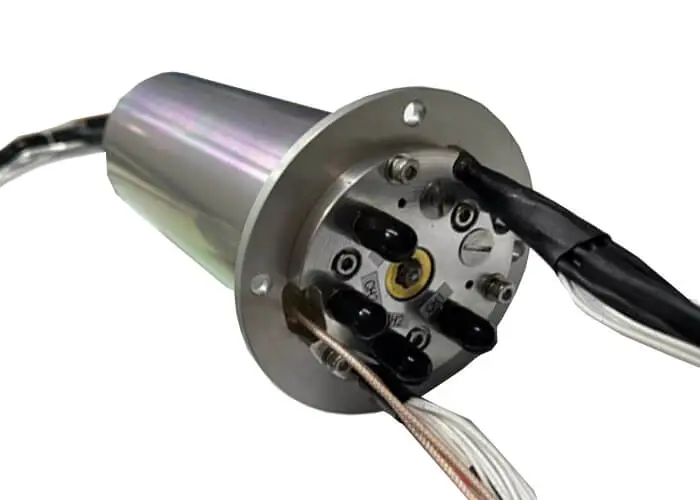
Introduction
In today’s interconnected world, uninterrupted data transmission has become the foundation of modern communication, sensing, defense, aerospace, and industrial automation systems. As equipment becomes more intelligent and mobile, engineers increasingly face a fundamental challenge: how can high-frequency signals be transmitted reliably between stationary and rotating structures?
Traditional cable assemblies can only tolerate limited rotation before twisting, wearing out, or failing completely. In applications where continuous 360-degree rotation is required, a different solution is necessary.
This is where the RF slip ring, also known as an RF rotary joint, coaxial rotary joint or microwave rotary joint, becomes indispensable.
Although RF slip rings are rarely visible to end users, they are critical components inside radar systems, satellite communication terminals, antenna tracking platforms, unmanned vehicles, medical imaging equipment, and industrial automation systems. Without them, many of the technologies that support modern society simply would not function.
As industries transition toward 5G, 6G, satellite internet, autonomous systems, and advanced sensing technologies, the demand for reliable high-frequency rotary transmission continues to accelerate.
This guide provides a comprehensive examination of RF slip ring technology, including operating principles, product classifications, technical specifications, industry challenges, application sectors, emerging innovations, and future market opportunities.
Table of Contents
ToggleWhat Is an RF Slip Ring?
An RF slip ring is a specialized rotary transmission device designed to transfer radio frequency signals across a rotating interface while maintaining signal integrity.
Unlike conventional electrical slip rings, which primarily transfer power or low-frequency electrical signals through brushes and rings, RF slip rings are engineered specifically for microwave and high-frequency applications.
Their primary purpose is simple but technically demanding:
Transmit high-frequency RF signals continuously while allowing unlimited rotational movement.
The device establishes a stable transmission path between a stationary section and a rotating section, enabling antennas, sensors, and communication systems to rotate freely without interrupting signal flow.
Because RF signals are highly sensitive to impedance mismatches, reflections, electromagnetic interference, and transmission losses, RF slip rings require far greater engineering precision than traditional slip rings.
RF Slip Ring vs. Standard Electrical Slip Ring
Many people mistakenly assume RF slip rings are merely upgraded electrical slip rings.
In reality, the design philosophies are fundamentally different.
| Feature | Electrical Slip Ring | RF Slip Ring |
|---|---|---|
| Signal Type | Power and low-frequency signals | High-frequency RF signals |
| Frequency Range | DC to MHz | MHz to GHz |
| Design Focus | Current transmission | Signal integrity |
| Critical Parameter | Current capacity | Insertion loss |
| EMI Sensitivity | Moderate | Extremely high |
| Manufacturing Precision | High | Ultra-high |
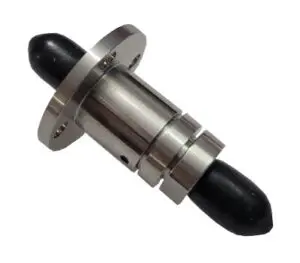
Even a tiny impedance variation that would be insignificant in a power circuit can severely degrade RF transmission quality.
This is why RF rotary joints demand advanced engineering and manufacturing techniques.
How Does an RF Rotary Joint Work?
At its core, an RF rotary joint maintains a controlled electromagnetic transmission path while one side rotates relative to the other.
The operating principle involves:
- Maintaining constant impedance
- Minimizing insertion loss
- Controlling reflections
- Preserving phase stability
- Isolating adjacent channels
As rotation occurs, the electromagnetic field continues to propagate through a precisely engineered transmission structure.
Unlike conventional slip rings that depend on sliding electrical contacts, many high-performance RF rotary joints utilize carefully designed coaxial or waveguide architectures to preserve signal quality.
The design challenge becomes increasingly difficult as operating frequencies rise.
At millimeter-wave frequencies, even microscopic dimensional changes can impact performance.
Main Types of RF Slip Rings
Coaxial RF Rotary Joints
Coaxial RF rotary joints are the most widely used configuration.
They support a broad frequency range while maintaining compact dimensions.
Advantages include:
- Cost efficiency
- Compact size
- Excellent broadband performance
- Easy integration
Typical applications include:
- Surveillance systems
- Commercial communication equipment
- Industrial automation platforms
- Ground-based antenna systems
Waveguide Rotary Joints
Waveguide rotary joints are used when maximum power handling and minimum signal loss are required.
These devices operate by guiding electromagnetic waves through precision waveguide structures.
Advantages include:
- Extremely low insertion loss
- High-power handling
- Excellent isolation
- Superior performance at microwave frequencies
Common applications include:
- Air-defense radar
- Naval radar
- Electronic warfare systems
- Satellite communication terminals
Single-Channel RF Rotary Joints
Single-channel models support one RF path.
They are commonly used when system architecture requires only a single signal transmission channel.
Benefits include:
- Simpler design
- Lower cost
- Compact dimensions
- Reduced maintenance requirements
Multi-Channel RF Rotary Joints
Multi-channel configurations support several independent RF paths simultaneously.
Applications include:
- Dual-polarized radar systems
- Multi-band communication platforms
- Advanced satellite systems
- Integrated sensor arrays
Hybrid RF Slip Rings
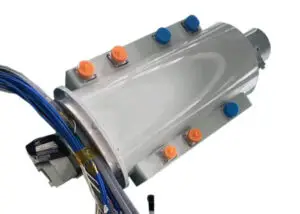
Hybrid designs combine multiple transmission technologies into one assembly.
A hybrid rotary joint may integrate:
- RF channels
- Electrical power circuits
- Ethernet communication
- Fiber optic channels
- Hydraulic passages
- Pneumatic passages
Hybrid designs are increasingly popular because they reduce system complexity and installation costs.
Critical High-Frequency Slip Ring Performance Parameters
Selecting a high frequency rotary joint requires careful evaluation of several technical specifications.
Insertion Loss
Insertion loss measures the amount of signal power lost during transmission.
Lower insertion loss generally indicates better performance.
For modern radar and communication systems, minimizing insertion loss is often the highest priority.
Excessive loss can reduce:
- Detection range
- Communication reliability
- Signal-to-noise ratio
- System efficiency
VSWR (Voltage Standing Wave Ratio)
VSWR evaluates impedance matching.
A lower VSWR indicates better energy transfer and fewer reflections.
Poor VSWR can create:
- Signal distortion
- Power loss
- Component overheating
Isolation
Isolation measures how effectively individual channels are separated.
High isolation prevents:
- Cross-talk
- Interference
- Signal contamination
This parameter becomes increasingly important in multi-channel systems.
Frequency Range
Different RF rotary joints support different operating frequencies.
Common frequency bands include:
- L-band
- S-band
- C-band
- X-band
- Ku-band
- Ka-band
- V-band
- W-band
The expansion toward higher frequencies is one of the most important trends shaping the industry.
Power Handling
Power handling capability determines how much RF energy can pass through the device safely.
High-power radar systems often require specialized rotary joints capable of handling substantial power levels without overheating.
Phase Stability
Phase stability is critical for:
- Phased-array radar
- Electronic warfare
- Precision tracking systems
- High-speed communications
Small phase variations can degrade overall system performance.

Major Applications of RF Rotary Unions
Radar Systems
Radar remains the largest application sector for RF rotary unions.
Virtually every rotating radar platform depends on rotary transmission technology.
Applications include:
- Air traffic control
- Weather monitoring
- Missile defense
- Maritime surveillance
- Border security
Modern radar systems require:
- Continuous rotation
- High power transmission
- Exceptional reliability
- Minimal signal distortion
These requirements place enormous demands on RF rotary joint performance.
Satellite Communications
Satellite ground stations require continuous antenna movement to maintain communication links.
RF rotary joints enable:
- Satellite tracking
- Ground station communication
- Earth observation systems
- Deep-space communication networks
As Low Earth Orbit constellations continue expanding, demand for high-performance RF rotary joints is expected to increase significantly.
Electronic Warfare Systems
Electronic warfare environments are among the most challenging operating conditions.
Systems must function reliably despite:
- Intense vibration
- Harsh climates
- High electromagnetic interference
RF rotary joints play a crucial role in maintaining signal quality under these demanding conditions.
Aerospace and UAV Platforms
Weight reduction remains a major design objective in aerospace engineering.
Modern UAVs increasingly integrate:
- Radar
- Communications
- Surveillance systems
- Electronic intelligence payloads
Miniature RF rotary joints help achieve performance goals while minimizing weight.
Medical Equipment
Medical imaging technologies increasingly incorporate rotating RF systems.
Applications include:
- CT scanners
- Advanced imaging platforms
- Rotational diagnostic equipment
Reliability and precision are especially important in healthcare environments.
Industrial Automation
Industry 4.0 continues to drive demand for intelligent rotating systems.
Applications include:
- Robotic arms
- Automated inspection equipment
- Rotating sensors
- Autonomous manufacturing systems
RF slip rings support uninterrupted communication during continuous movement.
Global Market Drivers
Defense Modernization Programs
Defense spending remains a primary growth driver.
Governments worldwide continue investing in:
- Radar modernization
- Missile defense
- Naval systems
- Surveillance infrastructure
Each of these sectors requires advanced RF rotary joint technologies.
Satellite Internet Expansion
Commercial space initiatives are reshaping the communications industry.
Large-scale satellite constellations require:
- Ground tracking antennas
- User terminals
- Communication gateways
All of these systems depend on reliable RF transmission technology.
Growth of 5G and 6G
The shift toward millimeter-wave frequencies presents both opportunities and challenges.
Future wireless infrastructure requires:
- Higher bandwidth
- Lower latency
- Greater frequency utilization
RF rotary joint manufacturers are developing solutions capable of supporting these advanced networks.
Autonomous Systems
Autonomous vehicles increasingly rely on:
- Radar
- Lidar
- Wireless communications
- Sensor fusion
Many of these technologies require rotating transmission systems.
Challenges Facing RF Slip Ring Manufacturers
Precision Manufacturing Requirements
Manufacturing tolerances often reach the micron level.
Even minor dimensional deviations can affect:
- Impedance matching
- Signal loss
- Isolation
- Phase stability
This precision requirement significantly increases production complexity.
Thermal Management
As frequencies and power levels increase, thermal challenges become more severe.
Engineers must carefully manage:
- Heat generation
- Material expansion
- Thermal drift
Failure to control temperature can degrade performance.
Material Costs
Advanced RF rotary joints often utilize:
- Precious metal plating
- Aerospace alloys
- Specialized dielectrics
- Ceramic materials
These materials contribute significantly to overall product cost.
Customization Demands
Many RF rotary joints are application-specific.
Customers often require unique combinations of:
- Frequency bands
- Channel counts
- Environmental ratings
- Mechanical interfaces
This limits economies of scale.
How to Choose the Right RF Slip Ring
Selecting the correct RF rotary joint requires careful analysis of application requirements.
Key considerations include:
Frequency Range
Determine current and future operating frequencies.
Channel Count
Evaluate both present and future signal transmission needs.
Environmental Conditions
Consider:
- Temperature
- Humidity
- Corrosion exposure
- Shock and vibration
Power Requirements
Ensure sufficient RF power handling capability.
Mechanical Constraints
Evaluate:
- Size
- Weight
- Rotational speed
- Mounting requirements
Maintenance Expectations
Long-life designs may provide lower total ownership costs.
Conclusion
RF slip rings have evolved from niche components into critical building blocks of modern communication, sensing, defense, aerospace, and automation systems.
As industries demand faster data transmission, higher frequencies, and more sophisticated rotating platforms, the importance of RF rotary joints continues to grow.
Although technical challenges remain—including thermal management, precision manufacturing, and cost control—the industry is advancing rapidly through innovation in miniaturization, millimeter-wave technology, hybrid integration, and intelligent monitoring.
For engineers, procurement specialists, system integrators, and technology developers, understanding RF slip ring technology is no longer optional. It is an essential part of designing reliable, future-ready systems capable of meeting the demands of an increasingly connected world.