
A comprehensive engineering guide for design engineers, procurement specialists, and technical evaluators — covering electrical slip ring assembly structure and design.
Table of Contents
ToggleWhat Is an Electrical Slip Ring Assembly?
An electrical slip ring assembly is an electromechanical device that enables the continuous transmission of electrical power, control signals, sensor data, and industrial communication protocols between stationary and rotating structures. Also known as a rotary electrical joint, collector ring assembly, or rotary electrical connector, it eliminates cable twisting and allows unrestricted 360-degree rotation.
A typical electrical slip ring assembly consists of a rotor, stator, collector rings, brushes, bearings, insulation components, seals, and external wiring interfaces. The design of these components directly influences electrical noise, contact resistance, service life, rotational speed capability, and environmental reliability.
For engineers evaluating custom slip ring solutions, understanding the assembly structure and contact system design is critical to selecting the right rotary electrical interface for long-term performance.
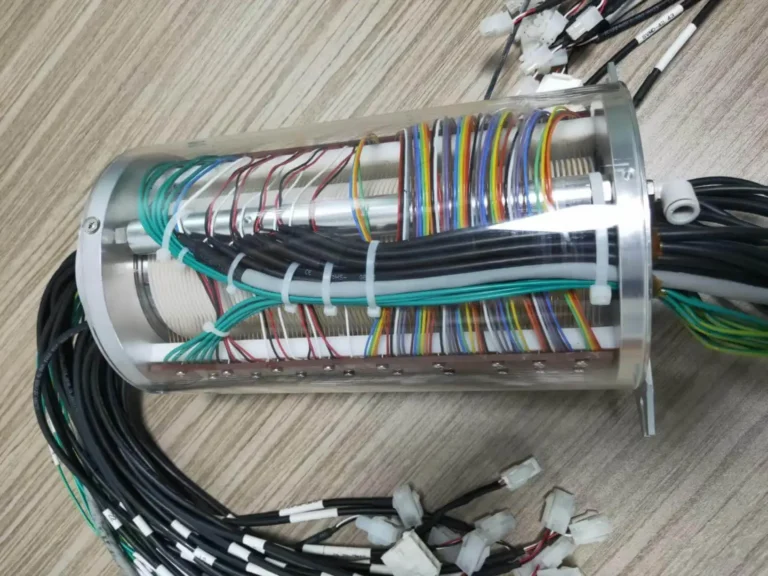
Electrical Slip Ring Assembly Structure and Contact System Design
Inside every slip ring assembly — whether it is called a rotary electrical joint or a brushed rotary connector — six major component groups must be arranged in three-dimensional space while simultaneously meeting electrical isolation requirements, mechanical stability constraints, and assembly sequence logic.
Central Shaft and Collector Ring Stack Assembly
The central support shaft is the mechanical backbone of the entire rotor and is equally critical in through-bore slip rings, capsule slip rings, and high-speed custom slip ring assemblies. It must simultaneously maintain geometric concentricity for stable brush contact, transmit rotational torque without deflection, and serve as the assembly mandrel onto which collector rings and insulation spacers are stacked. This structure is the single highest-leverage mechanical decision in any slip ring or rotary electrical connector design.
Concentricity requirements and tolerance allocation:
During operation, the rotary electrical interface is a sliding electrical contact. If the rotor runs out of true, the brush contact force varies cyclically, producing arc erosion (electrical pitting) and increased electrical noise. To prevent this on any collector ring assembly, the overall assembled coaxiality of the rotor stack must be held to ≤ 0.12 mm. This tolerance budget is allocated across the component chain: the central support shaft itself is machined to a concentricity of ≤ 0.04 mm; each individual copper collector ring is machined to ≤ 0.02 mm concentricity and ≤ 0.02 mm parallelism on its contact faces. The remaining tolerance is consumed by assembly variation — making the stacking sequence and clamping method critical controlled process steps.
WayDun Technology Field Note: Field experience across multiple industrial slip ring installations confirmed zero incidents of ring-track burnout and zero brush-jump events after adoption of this three-tier coaxiality budget (shaft ≤0.04 mm, ring ≤0.02 mm, assembly ≤0.12 mm). Communication signal stability improved markedly compared to the previous uncontrolled-tolerance approach.
Ring and insulation spacer stack construction:
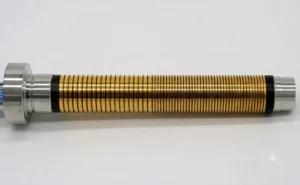
Collector rings and insulation spacers are assembled in an alternating interleaved pattern — ring, spacer, ring, spacer — forming a continuous cylindrical stack. This stack is pressed onto the central support shaft and clamped axially by a shaft flange plate at the base and a top compression plate secured with screws. This clamping architecture ensures that the entire stack behaves as a rigid unified rotor rather than a collection of loose components that could shift under vibration or thermal cycling. The collector rings themselves carry a V-profile groove on the outer contact diameter.
Insulation spacer design — anti-skip ledge feature:
A less obvious but practically critical detail is the outer diameter geometry of the insulation spacer. Standard flat-face spacers allow the brush spring filament to migrate from its intended ring slot into an adjacent slot if there is any axial shaft movement or if assembly tolerances permit the filament to ride up over the spacer shoulder — a failure mode that creates dead shorts or circuit cross-connections. To eliminate this, precision injection-molded spacers incorporate an enlarged outer diameter and a stepped anti-skip ledge on the lower sliding face. This ledge provides a positive mechanical stop that prevents brush filament migration during operation of the rotary electrical connector — a design refinement that field experience has proven essential in high-vibration and high-speed applications.
WayDun Technology Field Note: Since adopting the enlarged-OD anti-skip spacer, no brush-jump failures have been recorded in field-deployed slip ring units, including those operating at elevated speed with external shock and vibration loading.
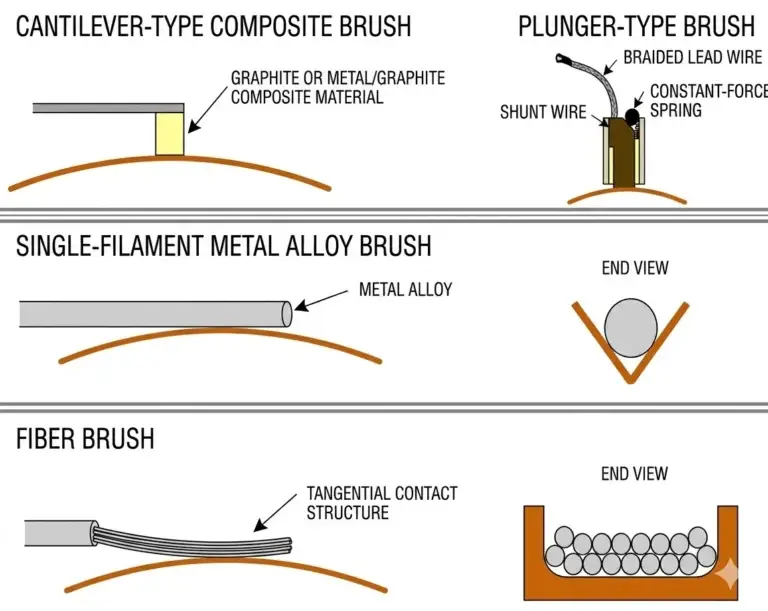
Brush System Design — Cantilever Architecture and Multi-Point Contact
The brush is the stationary contact element that maintains electrical continuity against the rotating collector ring surface. Brush design is the single greatest determinant of noise level, contact resistance stability, and service life in industrial slip rings, Ethernet slip rings, encoder slip rings, and other precision signal transmission systems.
Brush filament construction — cantilever beam:
Each brush filament in a precision slip ring or collector ring assembly is a composite structure: a precious-metal contact tip (gold alloy or palladium-silver) is welded onto a beryllium-copper cantilever spring arm to form the complete filament. Beryllium-copper’s exceptional spring-back characteristics and fatigue resistance maintain consistent contact force over millions of flex cycles without set relaxation. The filament is retained in the brush holder by a snap-lock (clip-type) mechanism that fits into a gold-plated slot machined directly into a printed circuit board (PCB). This PCB-based holder standardizes brush positions across a multi-circuit rotary electrical connector, simplifies field replacement without soldering, and provides a solderable land for lead-wire connection from each circuit.
Multi-point contact topology:
The number of contact points per circuit in a slip ring or collector ring assembly is deliberately differentiated based on the electrical demands of each circuit type — not kept uniform. Signal and control circuits, which must carry millivolt-level analog voltages or timing-critical digital pulses with minimal noise. This parallel-contact architecture distributes current across many simultaneous contact points, dramatically reducing the dynamic contact resistance variation that would otherwise manifest as electrical noise or excessive heat in the rotary electrical interface.
Brush pressure and contact force:
Brush pressure is the most influential single parameter for contact resistance in any rotary electrical connector or current collector. Higher pressure reduces contact resistance and improves signal integrity, but excessive pressure accelerates collector ring wear and brush tip erosion. The design goal is to establish a pressure range — typically 30–150 grams-force per contact point for precious-metal fiber brushes, and 200–600 gf for carbon-block brushes — that keeps contact resistance within specification throughout the brush wear life. Setting initial brush force 15–20% above the minimum required provides a maintenance margin as the beryllium-copper spring gradually relaxes over service life.
Brush-to-ring material pairing: Gold-plated collector rings mated with gold-alloy fiber brushes give the lowest and most stable contact resistance — the standard for encoder, analog sensor, and digital bus circuits in any precision slip ring. For high-current power circuits in a rotary electrical joint, silver-plated copper rings paired with graphite-carbon composite brushes offer high conductivity at much lower cost per ampere.
Anti-vibration brush holder design: In mobile platforms or machinery subjected to external vibration, brush holders in the slip ring assembly must be stiff in the radial direction (preventing bounce) but compliant axially (following runout). Preloaded dual-spring designs or damped holders are specified for helicopter collector ring assemblies, vehicle-mounted rotary connectors, and offshore rotating equipment.
Channel Segregation and EMI Management
Routing power and signal circuits through the same slip ring — or rotary electrical connector — body without careful segregation reliably produces system-level signal corruption. Best practices for any collector ring assembly, custom slip ring, or hybrid rotary electrical interface include:
Physical separation:
Group all high-current power collector rings at one end of the rotor stack; place sensitive low-level signal rings (millivolt-range thermocouples, strain gauge bridges, 4–20 mA loops) at the opposite end, with at least one grounded shield ring between zones.
Shielded circuits:
Differential signal pairs (CAN, RS-485, Ethernet) run on twisted pairs in shielded conduits from the brush pigtail to the system connector. The shield terminates at the slip ring ground ring — not at both ends — to avoid ground loops.
RF and high-speed data:
Coaxial RF circuits (50 Ω or 75 Ω) and Gigabit Ethernet use dedicated coaxial rotary joints or fiber-optic rotary joints (FORJs) integrated with the electrical slip ring in a hybrid rotary interface assembly. Routing RF or GigE through standard brushed contacts above ~100 MHz introduces unacceptable insertion loss and return-loss variation.
Ground ring and chassis bonding:
A dedicated ground ring bonded to the housing minimizes common-mode voltage between rotor and stator grounds. In multi-circuit rotary connectors, each voltage domain (3.3 V logic, 24 V power, 400 VAC) receives its own ground return ring to prevent ground-current-induced noise.
Bearing, Seal and Housing Architecture
Bearing selection and preload:
Deep-groove ball bearings (ABEC-5 or ABEC-7 grade) are standard in collector ring assemblies; angular-contact pairs are used where significant axial thrust is present. Light preload (5–20 N axial) eliminates radial play that would cause ring runout. Lifetime-lubricated, shielded bearings are the default; open bearings with regreasing provisions are specified for high-temperature or very long life slip ring applications.
Seal design:
IP54 uses a labyrinth or lip seal at each shaft penetration. IP67/IP68 requires O-ring face seals and potted cable entries. The seal elastomer is chosen for operating environment: EPDM for general use, FKM/Viton for chemical resistance, silicone for low-temperature flexibility in outdoor rotary electrical interfaces.
Housing material:
Housing material selection is particularly important for offshore slip rings, military slip rings, wind turbine slip rings, and outdoor industrial rotary connectors. Aluminum alloy (6061-T6 or 7075-T6) is the default for weight-sensitive rotary joint applications; stainless steel (316L) for marine and food-processing environments; engineering thermoplastics (PPS, PEEK) for aerospace secondary structures. Housing tolerance must maintain brush-to-ring alignment across the full operating temperature range — thermal expansion mismatch between housing and rotor can shift brush contact force significantly.
Contact Track Geometry: Flat, U-Groove and V-Groove Profiles
The cross-sectional profile of the collector ring’s contact surface — the track, slideway, or ring groove geometry — has a profound and often underappreciated effect on brush stability, debris tolerance, electrical noise, and suitability for different signal types in any slip ring or rotary electrical connector. Three geometries are in common use:
Track Profile | Axial Restraint | Debris Tolerance | Noise Performance | Recommended Use |
Flat / Planar | None — brush slides freely under axial shaft movement | Low — debris trapped under full contact area degrades CR | Sensitive to shaft runout and installation misalignment; SNR degrades under vibration | Stable, vibration-free drives; easy brush pressure adjustment; not for weak signal |
U-groove | Partial — groove walls limit axial travel but contact arc traps debris | Poor — arc contact captures contamination; unsuitable for millivolt signals | Higher CR variation than V-groove; not recommended for data or sensor circuits | Low-noise requirements should avoid U-groove; suitable only for robust power circuits in clean environments |
V-groove (60°–120°) | Full — wedge geometry prevents axial brush migration under shock, vibration, and centrifugal loading | Excellent — only A and B points contact; the ACB triangular cavity accumulates and self-expels debris during rotation | Lowest dynamic CR variation; highest SNR; preferred for signal, encoder, and data circuits | Recommended default for multi-environment designs; angle tuned by noise measurement (narrower = more self-cleaning) |
The V-groove profile is the recommended default for most slip ring, rotary joint, and collector ring assembly applications because its two-point contact geometry (contact at points A and B only, with the triangular ACB cavity between them) actively separates the brushed rotary contact surface from accumulated debris. During rotation, relative sliding motion drives wear particles and contamination into the ACB cavity, where they are retained away from the electrical contact zone and gradually expelled — a self-cleaning mechanism absent from flat and U-groove profiles.
V-groove angle selection:
The included angle of the V-groove track in a slip ring or rotary electrical connector is typically specified between 60° and 120°. A narrower angle produces more pronounced self-cleaning action and better axial restraint, but increases contact stress at points A and B, potentially accelerating ring wear. A wider angle is gentler on the collector ring surface but provides less debris-relief volume. The optimal angle is determined empirically by measuring dynamic electrical noise (contact resistance variation) across a range of angles under representative operating conditions.
Flat profile — when appropriate:
Flat-profile collector rings remain valid in clean, vibration-free, precision-aligned installations such as laboratory turntables or instrument gimbals. They are easier to machine and allow brush contact area to be adjusted by shimming the holder. They are not appropriate for multi-environment industrial slip ring applications where contamination or shaft runout are realistic operating conditions.
U-groove — a design to avoid for signal circuits:
The U-groove provides limited axial restraint but its arc-contact geometry is fundamentally problematic for signal integrity in any rotary electrical connector or current collector. Debris entering the groove is trapped under the full contact arc, increasing contact resistance unpredictably. U-groove tracks are not recommended for circuits carrying weak analog signals, encoder pulses, or any data bus where contact resistance stability is critical.
Engineering and Manufacturing Capabilities for Custom Slip Ring Solutions
While the fundamental principles of slip ring design are universal, the actual performance of a slip ring assembly depends heavily on manufacturing capability, process control, and application-specific engineering experience.
Article for Help Engineers to Know Slip Ring Well
For demanding applications such as industrial automation, defense systems, offshore equipment, robotics, medical imaging, and high-speed rotating platforms, standard catalog products often cannot fully satisfy electrical, mechanical, or environmental requirements.
Hangzhou WayDun Technology as a professional custom slip ring manufacturer should be capable of providing:
- Multi-circuit power and signal integration
- Gigabit Ethernet slip rings
- Fiber optic rotary joint (FORJ) integration
- High-current slip ring assemblies
- High-speed rotary electrical connectors
- Through-bore slip rings
- Compact capsule slip rings
- Hybrid electro-optical rotary interfaces
- IP65, IP67, and IP68 environmental protection
- Application-specific EMC and EMI optimization
Engineering evaluation should include not only electrical specifications but also manufacturing tolerances, plating quality control, brush life verification, environmental testing, and long-term reliability validation.
For mission-critical applications, custom-designed slip ring assemblies frequently provide superior performance, longer service life, and lower total ownership cost compared with off-the-shelf alternatives.
Frequently Asked Questions about Slip Rings Assembly
What are the main components of an electrical slip ring assembly structure?
Six main component groups: (1) central support shaft — the machined rotor backbone maintaining coaxiality; (2) collector rings and insulation spacers — alternately stacked in an interleaved cylinder clamped by flange plate and top compression plate; (3) brush assembly — beryllium-copper cantilever spring arms with precious-metal contact tips; (4) stator housing — holds brush holders and provides mounting; (5) bearings and seals — maintaining rotor concentricity and environmental protection; (6) lead wires and connectors — external electrical interfaces on both the rotating and stationary sides.
What are the differences between flat, U-groove, and V-groove slip ring tracks?
Flat-profile tracks are easy to machine and allow brush pressure adjustment, but are sensitive to axial shaft movement, contamination, and vibration — suitable only for clean, vibration-free, precision-aligned installations. U-groove tracks provide limited axial restraint but trap debris under the contact arc, making them unsuitable for signal or data circuits in any rotary electrical connector. V-groove tracks (60°–120° included angle) prevent axial brush migration, provide a self-cleaning ACB triangular debris-relief cavity, and deliver the lowest dynamic contact resistance variation — the recommended default for any slip ring or rotary joint handling signal, encoder, or data circuits in a demanding environment.
How to Select the Right Electrical Slip Ring Assembly?
When selecting a slip ring assembly, engineers should evaluate the following parameters:
- Number of circuits
- Operating current and voltage
- Signal and data protocols
- Rotational speed
- Through-bore size requirements
- Environmental protection level
- Operating temperature
- Installation space limitations
- Expected service life
- Maintenance requirements
For complex systems involving Ethernet communication, fiber optic transmission, high-current power delivery, or harsh operating environments, a custom slip ring solution is often recommended to achieve optimal performance and long-term reliability.
Conclusion
Electrical slip ring assembly design is a multidisciplinary engineering task involving mechanical structure, contact system architecture, material selection, surface treatment, insulation design, EMI management, and manufacturing precision.
From rotor concentricity and brush contact stability to plating quality and environmental protection, every design decision directly affects electrical performance, operational reliability, and service life.
For applications involving high-speed rotation, high-current transmission, industrial communication protocols, or harsh operating environments, selecting the appropriate slip ring architecture is essential to ensuring long-term system performance.
Understanding the principles discussed in this guide enables engineers, system integrators, and procurement specialists to make more informed decisions when evaluating slip ring assemblies and rotary electrical interfaces.