
Quick Answer: Miniature slip ring manufacturing involves nine tightly controlled stages: raw material qualification, rotor machining and ring soldering, injection molding, rotor finishing, stator assembly with ultrasonic cleaning, housing integration, semi-finished inspection, cable termination, and multi-parameter electrical and mechanical testing. Each stage is governed by precision tolerances — ring concentricity is typically held within ±0.005 mm — because even microscopic deviations cause brush bounce, elevated contact resistance, and early field failure.
Table of Contents
Toggle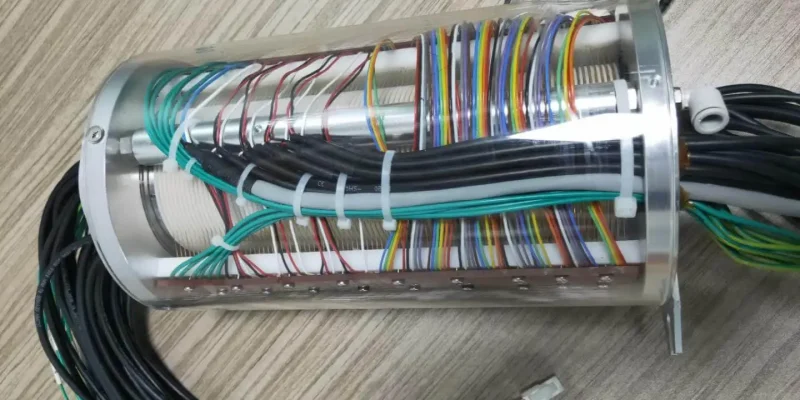
Manufacturing decisions at every stage are driven by the functional architecture of the finished product. A miniature slip ring is built around four integrated sub-systems, and defects introduced in any one of them propagate through to the final electrical performance.
Sub-system | Function | Manufacturing priority |
Rotor assembly | Carries conductive rings and lead wires on the rotating shaft | Concentricity, ring surface finish, solder joint integrity |
Stator assembly | Houses precious metal brushes in a fixed geometry relative to the rotor rings | Brush spring force consistency, precise positioning, cleanliness |
Bearing system | Maintains alignment and smooth rotation throughout service life | Dimensional tolerance, pre-load, lubrication |
Housing | Provides structural support and environmental protection | Sealing, dimensional accuracy, material compatibility |
Raw Material Preparation and Incoming Inspection
High-reliability miniature slip ring production begins long before any machining takes place. Material quality sets the ceiling for everything that follows — no amount of precision assembly can compensate for conductive rings made from sub-specification alloy or bearings with inadequate radial runout.
Conductive Ring Materials
The ring material must balance electrical conductivity against wear resistance — pure copper offers excellent conductivity but wears quickly under brush contact. In practice, most high-reliability designs use copper alloys or plated copper substrates. The surface finish specification for incoming rings is critical: roughness values that are too high create abrasive wear; surfaces that are too smooth reduce brush seating and increase noise in the early rotation phase.
Brush Materials
Precious metal brushes — typically gold alloys or silver composites — are standard in miniature slip rings where low contact resistance and long service life take priority over cost. The contact material choice directly determines the noise floor: gold-on-gold contacts routinely achieve contact resistance below 10 mΩ and maintain stability over tens of millions of revolutions. Incoming brush materials are inspected for wire diameter consistency and spring temper, since brush force variation greater than ±10% across a batch will produce measurable differences in contact resistance between circuits.
Bearings
Precision miniature bearings for electrical slip ring applications are inspected for radial runout — values exceeding 2 to 3 μm will cause the rotor rings to oscillate relative to the brushes during rotation, producing electrical noise and accelerated wear.
Insulating and Molding Compounds
Engineering thermoplastics selected for the rotor body and housing must meet both mechanical and electrical specifications, thermal stability across the operating temperature range, and dimensional stability during and after molding. Lot traceability is maintained at this stage so that any field failures can be traced back to material batches.
Step 2: Miniature Slip Ring Rotor Manufacturing
The rotor is the most dimensionally demanding component in the assembly. It rotates continuously against stationary brushes, so any deviation from concentricity, surface flatness, or ring-to-ring spacing will manifest as electrical noise or accelerated brush wear.
Conductive Ring Machining
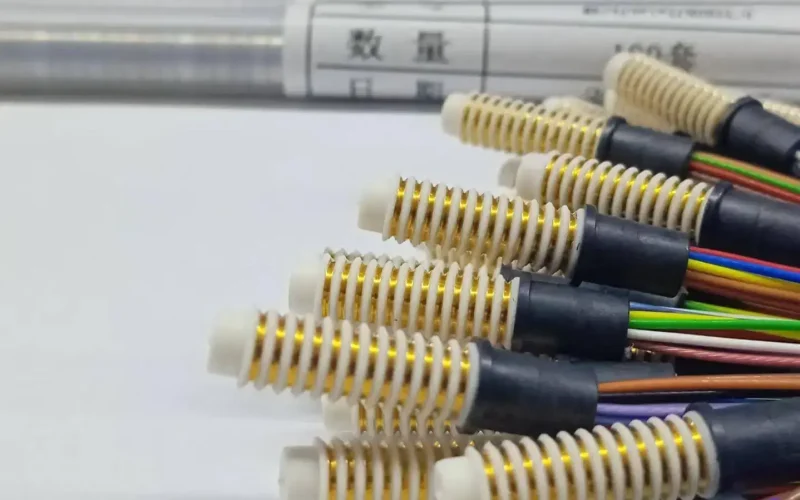
Conductive rings are machined to finished dimensions on precision CNC lathes. The critical controlled dimensions are outer diameter, ring width, ring pitch (center-to-center spacing between adjacent rings), and concentricity relative to the bore. Concentricity is typically controlled within ±0.005 mm in high-reliability applications — deviations beyond this range cause the brush tip to ride up and down on the ring surface, introducing resistance variation as a function of rotation angle. Surface roughness target values are held in the Ra 0.4 to 0.8 μm range to provide a stable brush seating surface without abrasive damage to the brush tip.
Lead Wire Preparation and Ring Soldering
Each ring must be electrically connected to its dedicated lead wire before the rotor body is molded. Lead wires are cut to length, stripped, and tinned. Soldering is performed with flux-cored solder under a temperature-controlled process — cold joints at this stage are a primary cause of intermittent signal failure in the field. Quality requirements include full solder penetration (no voids at the ring-wire interface), consistent joint geometry, and joint resistance measured by four-wire milliohm testing before proceeding. Any joint measuring above approximately 5 mΩ is rejected and resoldered.
Injection Molding of the Rotor Body
Once the rings and lead wires are soldered, the assembly is placed into a precision mold and the rotor body is injection-molded around it. The molding compound encapsulates the internal connections, provides ring-to-ring electrical isolation, and forms the shaft structure. This is an insert molding operation, and the process window is tight: injection pressure and temperature must be controlled to avoid displacing the rings from their positioned geometry, and cooling rate must be managed to prevent residual internal stress that could cause the body to crack or distort during temperature cycling in service.
After demolding, rotors are inspected for surface voids, short shots, and flash on the ring contact surfaces. Any flash on the ring face must be removed before the finishing stage — residual polymer on the contact surface will contaminate the brush and elevate resistance.
Step 3: Mini Slip Ring Rotor Finishing Operations
The molded rotor passes through a series of finishing operations before it is ready for bearing installation and integration into the final assembly.
Flux Residue Removal
Flux residues from the ring soldering process are removed using a controlled cleaning protocol. Residual ionic flux left on the rotor surface will absorb moisture, reduce insulation resistance between adjacent rings, and cause accelerated corrosion of the contact surface. In circuits carrying sensitive analog signals, even small amounts of ionic contamination can introduce noise floors that degrade signal quality.
Wire Organization and Trim
Lead wires are trimmed to finished length, organized, and dressed to prevent tangling or contact with the bearing seat. Poor wire management at this stage can cause wires to interfere with bearing installation or create internal short circuits when the assembly is under vibration.
Bearing Installation
Precision bearings are pressed or slip-fitted onto the rotor shaft within controlled temperature and force limits. The fit class determines whether the bearing is a press fit or a clearance fit onto the shaft — too loose and the bearing will spin on the shaft under load; too tight and the bearing race will be distorted, increasing friction and reducing service life. After installation, rotors are checked for axial play, radial runout, and rotational torque. Units with runout exceeding the process limit are rejected at this stage.
Step 4: Small Slip Ring Stator Manufacturing
The stator is the stationary half of the capsule small slip ring. It holds the brush assembly in precise geometric relationship to the rotor rings, and the quality of this relationship determines electrical performance across the life of the product.
Brush Positioning and Wire Insertion
Guide wires and brush contacts are positioned in the stator body according to the circuit layout. Contact geometry — the angle at which the brush tip meets the ring surface and the normal force applied at the contact point — is determined by the spring arm design and the positional accuracy of insertion. Brush normal force in miniature slip ring connectors typically falls in the range of 15 to 50 grams per contact, depending on the application. Force below this range produces intermittent contact; force above it accelerates ring wear. Both extremes shorten service life.
Brush-to-Wire Soldering
Electrical conductors are soldered to the brush assembly. The same solder quality standards apply as in rotor manufacturing — complete penetration, no voids, consistent joint resistance. Because the stator lead wires are the customer-facing interface for signal and power connections, the mechanical integrity of these joints must also withstand the pull forces that occur during connector mating and field installation.
Ultrasonic Cleaning
After soldering, the stator assembly is ultrasonically cleaned to remove flux residues, fine metallic particles from the machining or assembly process, and any other surface contamination. Ultrasonic cleaning is particularly important for the stator because the brush contact area must be free of any material that could introduce a resistance layer or transfer to the rotor ring surface during initial run-in. This stage has a measurable impact on the initial contact resistance values recorded at final test.
Adhesive Fixing
Structural adhesive is applied to secure internal components against vibration and shock loads. The adhesive must be compatible with the surrounding materials, must not outgas in the operating environment, and must cure without distorting the brush geometry. In vibration-intensive applications such as motor-mounted sensors or vehicle-mounted cameras, inadequate adhesive fixation is a common root cause of stator brush misalignment and resultant contact instability.
Step 5: Housing Preparation and Mechanical Assembly
The housing is machined or molded to final dimensions and inspected before the rotor and stator sub-assemblies are integrated. Housing bore concentricity is critical: the bore must be concentric with the bearing seat so that when the rotor is installed, the ring surfaces are centered within the stator brush array.
Final mechanical assembly integrates the rotor, stator, bearings, and housing into the finished electromechanical unit. The axial position of the stator relative to the rotor is adjusted to align each brush contact with the center of its corresponding ring. Radial alignment ensures even contact force distribution around the ring circumference. Contact pressure is set and verified — in miniature units this is often accomplished through the spring geometry of the brush itself, rather than through an adjustable mechanism.
Assembly personnel work under controlled conditions. Contamination from skin oils, dust, and metallic particles at this stage is a known failure mode — even particles in the range of 10 to 50 μm can become embedded in the brush contact area, causing elevated resistance readings at final test.
Step 6: Semi-Finished Product Inspection
Before cable termination and connector installation, every assembled unit undergoes a semi-finished inspection designed to catch assembly defects before the additional labor of wiring is applied. This gate inspection also provides data for process control — systematic patterns in rejection rates at this stage indicate upstream process drift.
Mechanical checks at this stage include manual rotation evaluation (the unit should rotate freely with no grinding, catching, or rough spots), measurement of rotational torque, and runout measurement under rotation. Electrical checks include four-wire continuity on every circuit, insulation resistance between all circuit pairs (typically measured at 100 V or 500 V DC, with acceptance values of 100 MΩ or higher at rated conditions), and short-circuit screening across all channel combinations.
Only units that pass all criteria at this gate proceed to cable processing. Units with marginal rotation feel or marginal insulation resistance are set aside for engineering review — they may reveal a systematic issue with a material lot or assembly parameter that requires corrective action.
Step 7: Cable Processing and Connector Installation
Mini slip ring connectors are supplied in a wide variety of termination configurations, and the cable processing stage implements the customer-specific wiring requirement. This is one of the most customized stages in the production process.
Lead wires are twisted in pairs where required to reduce inductive coupling between adjacent signal circuits. Wire lengths are cut to specification, stripped to precise bare conductor lengths, and crimped or soldered to the specified connector contacts. Crimp terminations are pull-tested to verify retention force — undersized crimps that pass visual inspection can still fail under the axial force of repeated connector mating in service. Connector bodies are installed and strain relief is applied where specified.
For OEM applications, this stage may also include labeling, circuit identification, and custom cable dressing per customer drawing. The flexibility of this stage is what allows the same fundamental slip ring to be integrated into a medical scanner, a radar antenna platform, or a robotic welding arm — each with different connector types, wire gauges, and cable exit configurations.
Step 8: Performance and Reliability Testing
Testing is the stage that converts a manufactured part into a verified product. In high-reliability miniature slip ring production, testing is not a final sampling process — every unit is tested individually across multiple parameters before it is approved for shipment.
| Parameter | Value |
|---|---|
| Operating temperature | -40°C to +85°C |
| Lifetime | up to 5–80 million revolutions |
| IP rating | IP54–IP67 (optional) |
Contact Resistance Testing
Contact resistance is measured on every circuit using a four-wire (Kelvin) method to eliminate lead resistance from the measurement. A typical acceptance criterion for a gold contact system is less than 30 mΩ per circuit at zero RPM, with a requirement to demonstrate resistance stability during rotation. The rotation test connects the unit under measurement, spins it at the rated RPM (or a standardized test speed), and records resistance variation as a function of rotation angle. Units showing peak-to-valley resistance variation greater than ±10 mΩ during rotation are investigated — this pattern typically indicates a ring surface contamination issue, a brush seating problem, or a bearing runout condition.
Insulation Resistance Testing
All circuit pairs — including rotor-to-stator isolation and channel-to-channel isolation — are tested under applied DC voltage. The applied voltage level is selected to match the application: signal circuits at 100 to 250 V DC, power circuits at 500 V DC or higher. Acceptance values are typically 100 MΩ minimum, with premium applications requiring 1,000 MΩ or above. Low insulation resistance at this stage most often traces back to contamination (ionic flux residue, particulates at the brush contact), a crack in the molded insulation, or a dimensional error that has allowed conductive elements to approach each other too closely.
Rotation and Noise Testing
The unit rotates under continuous electrical monitoring for a defined burn-in period. This run-in serves two purposes: it seats the brushes into the ring surface microgeometry (contact resistance typically decreases and stabilizes over the first few thousand revolutions), and it screens for early-life failures caused by latent defects that were not detectable at incoming or semi-finished inspection. Noise is measured across the full rotation at the specified RPM, and the noise floor is compared to the product specification. Units for analog signal applications typically require noise levels below 1 mΩ peak-to-peak during rotation.
Pull Force Testing
Connector and wire retention is verified by axial pull force testing. The test force is applied along the wire axis and held for a specified duration. This test screens for cold solder joints, improper crimps, and inadequately secured connectors that would not survive the mechanical environment of installation and field use.
Step 9: Final Quality Inspection and Shipment Approval
The final inspection stage integrates all quality data collected during manufacturing and tests to generate a per-unit shipment decision. Units that have passed all prior stages still undergo a comprehensive final check covering appearance, dimensions, electrical performance, and mechanical performance. (quality control process aligned with ISO 9001 standards)
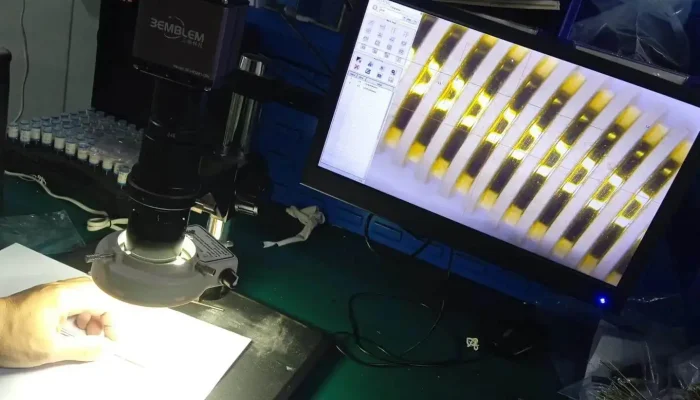
Appearance inspection under magnification checks for ring surface scratches, connector body damage, wire insulation nicks, and housing defects. Dimensional verification confirms shaft diameter, body outer diameter, mounting flange geometry, and overall length against the drawing. A final electrical sweep confirms continuity on every circuit and insulation resistance across all pairs. Rotational torque is measured and compared to the specification — excessive torque indicates a bearing preload issue or assembly interference that was not present immediately after assembly but has developed during the test rotation.
Units that pass every element of final inspection are serialized, documented, and packaged for shipment. In high-reliability supply chains, a test data record accompanies each unit so the end customer can verify that the delivered product meets specification without re-testing at incoming.
NOTE:If the rotary slip ring connector is suitable for outdoor applications (designed with IP65/IP67 protection level according to IEC 60529), waterproof testing is also required.
The Four Manufacturing Factors That Determine Long-Term Reliability
After walking through the full production process, it becomes clear that reliability is not the result of any single stage. It is the cumulative outcome of decisions made at every step. That said, four factors carry disproportionate weight.
1. Contact Material Pairing
The combination of ring material and brush material determines the tribological behavior of the contact. Mismatched materials produce excessive wear debris that raises contact resistance and accelerates failure. Gold-alloy brush on gold-plated copper ring is the standard pairing for low-noise, long-life signal applications. Silver-graphite brush on copper ring is common for higher-current applications where cost is a constraint. The wrong pairing for the application is one of the most common causes of premature field failure.
2. Bearing Precision and Preload
The bearing is the mechanical spine of the mini slip ring. A high-quality bearing with appropriate preload maintains the concentricity between the rotor rings and the stator brushes over the full service life. A marginal bearing — even one that passes incoming inspection — will develop increased radial play as the rolling element races wear, causing brush-ring misalignment and contact noise that progressively worsens over time.
3. Assembly Cleanliness and Process Discipline
Contamination is the hidden enemy of electrical contact reliability. Flux residues, skin oils, fine metallic particles, and airborne dust — any of these can create a resistance layer at the brush-ring interface that produces noise and erratic performance. Manufacturers who control contamination rigorously throughout the assembly process deliver units that perform to specification from day one and maintain that performance over years of service.
4. Systematic 100% Testing
Sampling-based testing is inadequate for high-reliability mini slip ring production. The defect modes that matter most — a single cold solder joint, a bearing with marginal runout, a stator brush slightly out of position — are low-frequency events that sampling will miss. Only 100% unit testing with rotation under electrical measurement provides the confidence needed for mission-critical applications. When evaluating a supplier, ask specifically about their test coverage: which parameters are measured on every unit, what are the acceptance criteria, and what test data is available for delivered product.
What This Means When You Are Evaluating a Slip Ring Supplier
Miniature slip rings look simple from the outside. The catalog specifications — number of circuits, rated current, speed, and dimensions — do not tell you anything about the manufacturing discipline behind the product. Two units with identical catalog specs can have service lives that differ by an order of magnitude depending on how they were built.
A manufacturer with well-documented process controls at each of the nine stages described in this article will be able to answer these questions directly and specifically. Vague or unavailable answers to process questions are a meaningful signal about quality culture.
For demanding applications in consumer electronics, industrial robotics, defense systems, and precision automation, understanding the manufacturing process behind your small slip ring is not optional — it is the foundation of a reliable integration. (meeting industrial reliability and safety requirements based on IEC and MIL reference standards)
Conclusion
High-reliability miniature slip ring manufacturing is a nine-stage process in which precision, cleanliness, and systematic testing at every step determine whether the finished product will perform as specified over millions of revolutions or fail prematurely in the field. The stages are interdependent: ring concentricity drives brush contact stability, brush force drives wear rate, bearing precision drives alignment, cleaning discipline drives insulation resistance, and 100% testing is the final verification that all prior stages were executed correctly.
The engineering content of a miniature slip ring is concentrated in the manufacturing process, not visible in the external dimensions. For engineers, buyers, and quality teams working with these components, understanding what good manufacturing looks like is the most practical tool available for selecting product that will deliver the expected service life.