
If you’ve ever searched for “rotary slip ring vs commutator” or “difference between a slip ring and a commutator” you’ve probably noticed that many articles use the two terms almost interchangeably. This confusion is understandable. Both components consist of rotating conductive surfaces and stationary carbon brushes, and both transfer electricity between stationary and rotating parts.
However, they are fundamentally different devices designed for completely different purposes.
Over the past ten years working with industrial slip rings for wind turbines, robotics, consumer electronics, medical imaging systems and automated production equipment, I have seen countless customers, maintenance engineers and even purchasing teams confuse slip rings with commutators. In one project, a customer requested replacement “commutators” for a VR device. After reviewing the assembly drawings, we discovered the machine actually used a multi-channel miniature slip ring transmitting power and USB/DP signals. Ordering the wrong component would have delayed the repair and significantly increased maintenance costs.
This kind of misunderstanding is surprisingly common. I want to explain the difference from an engineering perspective and provides practical examples to help you identify each device correctly.
Table of Contents
ToggleQuick Answer
A rotary slip ring is an electromechanical device that allows the transmission of power and electrical signals from a stationary to a rotating structure without changing the direction of current.
A commutator, on the other hand, is a mechanical switching device that reverses the current direction inside a brushed DC motor or generator, allowing continuous rotation.
In short:
- Slip Ring = Continuous Electrical Connection
- Commutator = Mechanical Current Reversal
Although they may appear similar, they should never be considered interchangeable.
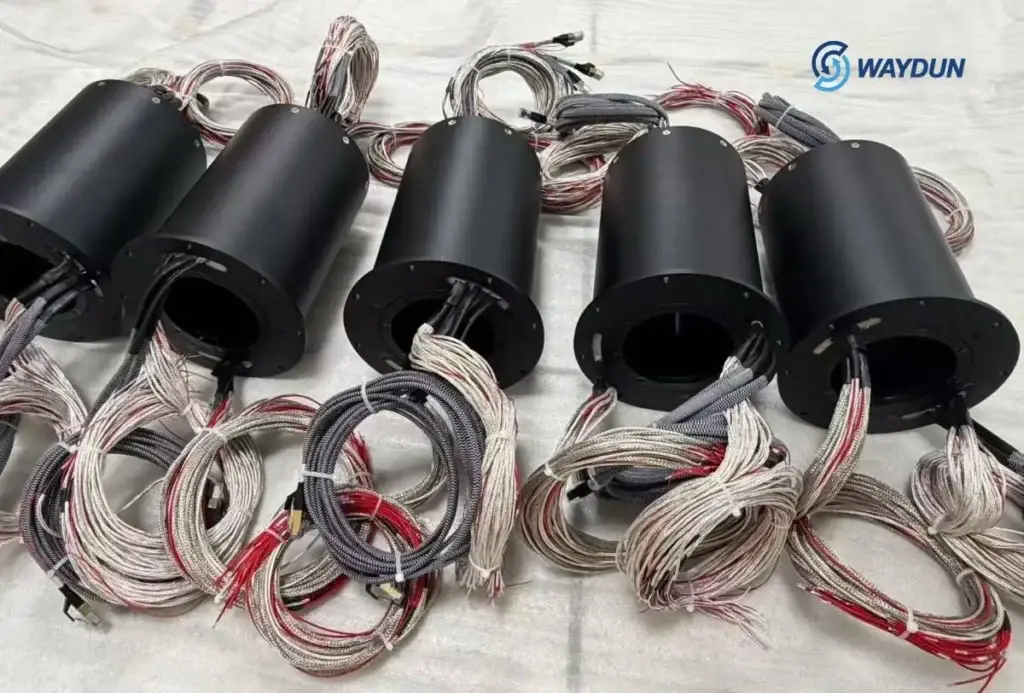
Rotary Slip Ring vs. Commutator Comparison
Feature | Slip Ring | Commutator |
Structure | Continuous conductive ring | Segmented copper bars insulated from each other |
Current Direction | Remains unchanged | Reverses every half rotation |
Primary Function | Power and signal transmission | Mechanical current switching |
Signal Transmission | Yes (Ethernet, CAN, USB, Fiber Optics, RF) | No |
Typical Applications | Wind turbines, robots, radar, CT scanners, packaging machines | Brushed DC motors and DC generators |
Electrical Noise | Very low under normal operation | Sparking during switching is unavoidable |
Maintenance | Long service intervals | Frequent brush inspection and replacement |
What Is a Rotary Slip Ring?
A collector ring is an electromechanical rotary interface—also known as a rotary electrical joint, slipring collector, or electrical swivel—that allows electricity, electrical signals or digital communication to pass from a stationary structure to a rotating assembly while maintaining continuous electrical contact.
Unlike a commutator, a rotary connector does not modify the electrical waveform or reverse current direction. It simply acts as a rotating electrical connector.
Modern industrial slip rings are capable of transmitting:
- AC and DC power
- Analog and encoder signals
- Industrial Ethernet and Gigabit Ethernet
- USB, HDMI, CAN Bus, RS-485
- Fiber optic communication (FORJ)
- Pneumatic and hydraulic media through hybrid rotary unions
Because of this versatility, rotary slip rings have become essential components in modern automation systems.
What Is a Commutator?
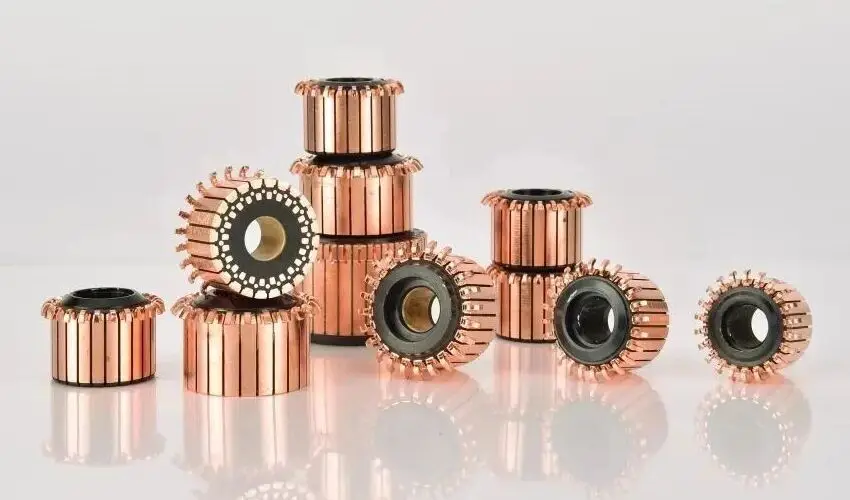
A commutator is a mechanical switching device found in brushed DC motors and DC generators. Rather than using a single continuous copper ring, it consists of many insulated copper segments.
As the rotor turns, carbon brushes move from one segment to another, reversing current direction every half rotation. From a deeper engineering standpoint, ScienceDirect’s technical reference notes that reversal of the current in any given coil involves a process by which the current is reduced to zero and then reversed in a controlled fashion—and that if this commutation process is not carefully controlled, sparking at the brush-commutator interface can cause significant damage.
Without this switching action, a brushed DC motor would stop after rotating only a small angle because the magnetic forces would reverse. Therefore, the commutator exists for one reason:
To mechanically reverse current inside the rotating armature.
The Three Biggest Differences
1. Continuous Ring vs. Segmented Ring
The easiest way to distinguish the two is by looking at the copper surface. A electrical slip ring connector has a smooth, continuous conductive ring. A commutator consists of multiple insulated copper segments separated by mica insulation.
This segmented construction enables electrical switching. If you can clearly see individual copper segments, you are looking at a commutator—not a slip ring.
2. Current Direction
This is the most important functional difference.
A electrical swivel simply transfers electricity. If DC enters the slip ring, DC exits unchanged. If AC enters the slip ring, AC exits unchanged. The electrical characteristics remain exactly the same.
A commutator behaves differently. It continuously reverses current inside the rotating winding, allowing the motor to produce torque in the same rotational direction.
3. Signal Transmission
Modern industrial equipment rarely transmits only electrical power. Today’s rotating systems often require encoder feedback, industrial Ethernet, camera signals, servo control, high-definition video, and fiber optic communication. These signals require extremely stable electrical contact with minimal electrical noise.
A properly designed industrial Ethernet slip ring can transmit both power and high-speed digital communication simultaneously. High-speed interfaces like 10/100/1000 Base-T Ethernet and USB 2.0/3.0 are now standard in modern slip ring assemblies, and are critical in applications like automation, robotics for sensor feedback, medical imaging for image transfer and surveillance for streaming high-resolution data.
A commutator cannot perform this role. Because brushes continuously jump between copper segments, sparking and electromagnetic interference (EMI) are unavoidable. Engineering analysis confirms that brushed DC motors produce EMI through two mechanisms: conducted emissions from voltage transients at the commutator, and radiated emissions from broadband RF noise caused by brush arcing and magnetic field switching. For this reason, commutators are entirely unsuitable for modern data transmission.
Why Do People Confuse Them?
The confusion comes from appearance. Both use carbon brushes, copper conductors, and rotating assemblies. At first glance they seem identical. Historically, some older textbooks and catalogs even referred to certain rotary electrical contacts as “slip-ring commutators,” adding to the misunderstanding.
The simplest rule is:
One continuous ring = a slip ring.
Multiple insulated segments = a commutator.
I noticed that a topic “Difference Between Slip Ring and Split Ring Commutators?” (from University of Illinois Urbana-Champaign, The Grainger College of Engineering, Physics Van) also confused.
The answer “So, slip rings are useful for DC motors where the current has to change direction every half revolution whereas split rings are used to make constant current connection to a commutator, which is what you want for an AC motor.”
It is wrong. Now we know rotary electrical interface provide a continuous electrical connection between a stationary circuit and a rotating conductor. They do not reverse the current.
A correct version would be:
Slip rings provide a continuous electrical connection between stationary and rotating parts without reversing the current. They are commonly used in AC generators, wound-rotor AC motors, and many rotating electrical systems. Split-ring commutators reverse the current in the rotor every half revolution, allowing brushed DC motors to produce continuous torque in one direction.
Where Are Rotary Slip Rings Used?
Today, rotary sliprings are found in thousands of industrial applications. Typical examples include:
- Wind turbines — where slip rings provide reliable power supply to rotor blade adjustment drives and flawless signal transmission of sensors including fieldbus and Ethernet communication
- Industrial robots
- CT scanners — where the rotating gantry requires continuous transmission of power and high-speed image data; state-of-the-art CT slip rings achieve aggregate transmission speeds reaching 20 Gbps or higher
- MRI systems
- Radar antennas
- Packaging machinery
- Semiconductor equipment
- Cable reels
- Rotary indexing tables
- Remote-controlled weapon stations
- Marine cranes
- Satellite communication systems
Many of these systems simultaneously transmit electrical power, Ethernet, encoder signals and optical communication through a single rotary interface.
Where Are Commutators Used?
Commutators are primarily found in brushed DC machines, including:
- Electric drills and portable power tools
- Automotive starter motors
- DC traction motors
- Small household appliances
- Laboratory DC generators
Although brushless motors have replaced brushed motors in many industries, commutators remain widely used because of their simple design and low manufacturing cost.
How to Identify Them in Seconds?
If you are standing in front of a machine and need to determine which component you’re seeing, ask these questions:
Does the copper surface form one continuous ring?
If yes, it is almost certainly a rotating electrical connector.
Does it consist of many insulated copper segments?
Then it is a commutator.
Next, consider the machine itself. If it is a wind turbine, industrial robot, CT scanner or radar system, the rotary electrical interface is almost certainly a slip ring. If it is a brushed DC motor, the rotating copper assembly is almost certainly a commutator.
Frequently Asked Questions
Can a rotary slip ring replace a commutator?
No. A rotary slip ring transfers electricity but cannot reverse current direction. A commutator performs current switching and cannot be replaced by a slip ring. As one DC motor engineering resource explains, if the application needs timed reversal in a brushed DC armature, a slip ring simply does not replace a commutator—its main function is to switch armature current at the right rotor position so the motor keeps producing unidirectional torque.
Why do commutators produce sparks?
Because the brushes repeatedly transfer contact between adjacent copper segments, electrical arcing naturally occurs during switching. No matter how good the commutation is, there will always be some sparks or arcing between these components—sparks have a very wide-bandwidth radio frequency emission, also naturally producing radio interference. Small sparks are normal in brushed DC motors.
《Some Important Aspects in the Phenomenon of Commutator Sparking》
Can electrical slip ring transmit Ethernet?
Yes. Modern industrial Ethernet slip rings can transmit Fast Ethernet, Gigabit Ethernet and depending on the design, even higher-speed communication while simultaneously carrying electrical power. In CT scanners, for example, optical data channels can achieve transmission speeds exceeding 5–10 Gbps per channel, essential for supporting detectors with hundreds of slices and high rotation speeds.
Do AC motors use commutators?
Most AC induction motors do not. Brushed DC motors require commutators. Many AC machines that need rotor excitation, however, use slip rings instead. Wikipedia’s engineering reference notes that slip rings are commonly found in electrical generators for AC systems and alternators, precisely because they maintain continuous connection without the current reversal that a commutator would impose.
Can slip rings transmit fiber optic signals?
Yes, that is a fiber optic slip ring. By integrating a Fiber Optic Rotary Joint (FORJ), modern slip ring assemblies can transmit high-speed optical communication while maintaining continuous rotation.
Final Thoughts
Although electric rotary joints and commutators may appear similar, they solve completely different engineering problems. A collector ring is designed to maintain a continuous electrical connection between stationary and rotating structures while preserving the original electrical signal. A commutator is designed to reverse current direction mechanically, enabling brushed DC motors and generators to operate correctly.
Understanding this distinction is more than an academic exercise. It helps engineers select the correct components, prevents costly purchasing mistakes, reduces maintenance errors and improves overall system reliability.
All engineering things you want to know about slip ring.
If you remember only one principle from this article, remember this:
A rotary slip ring transfers electricity. A commutator switches electricity.
About the Author
The author Mark Ma from Hangzhou WayDun Technology has more than ten years of experience in the design and application of rotary slip ring connectors, including capsule slip rings, through-bore slip rings, Ethernet slip rings and fiber optic rotary joints (FORJ). Over the past decade, the author has supported customers in industries such as wind energy, industrial automation, robotics and medical imaging, helping engineers select reliable rotary transmission solutions for demanding applications.