
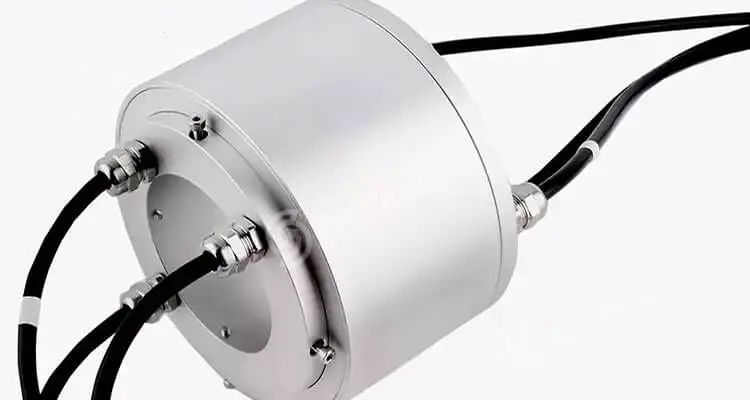
Operating temperature is a critical factor that directly affects the reliability and service life of an electrical slip ring.
Before selecting a conductive slip ring, equipment manufacturers must provide information about the actual operating environment, including temperature conditions, because different applications require different material selections and protection designs.
If a standard electrical slip ring operates beyond its designed temperature range, several problems may occur, including insulation degradation, increased contact resistance, reduced electrical stability, and shortened service life.
Now, let’s see how high temperature effects on electrical slip ring connectors.
Other factors affecting the performance of electrical slip rings.
Table of Contents
ToggleHigh Temperature Accelerates Insulation Material Aging
Electrical slip rings rely on insulation materials to maintain electrical separation between circuits.
Excessive temperature can cause organic insulating materials to become brittle, accelerate aging, reduce insulation performance and mechanical stability, even lead to dielectric breakdown.
Thermal reliability evaluation we can refer to environmental testing methods such as IEC 60068 environmental test procedures, depending on application requirements.
Thermal stress also reduces the service life of insulation materials.
For example, according to the general aging characteristics of insulating materials, when temperature increases within a specific operating range, the lifetime of insulation materials may decrease significantly. Certain Class A insulation materials can experience approximately a 50% reduction in service life for every temperature increase of around 8–10°C.
High temperature can also affect inorganic insulation materials.
For example, ceramic insulation materials may experience reduced dielectric strength as temperature increases. Materials that perform reliably at lower temperatures may show significantly lower breakdown resistance under elevated temperature conditions.
Therefore, selecting suitable insulation materials is essential for electrical slip ring rotary unions used in furnaces, industrial heating systems, aerospace equipment, and other high-temperature applications.
High Temperature Effects on Electronic Components
Many electrical slip ring systems integrate electronic components or transmit sensitive electrical signals.
High temperatures can negatively affect the performance of electronic components.
Excessive heat may cause:
- Semiconductor thermal breakdown
- Increased leakage current
- Reduced amplification performance
- Lower component reliability
As temperature rises, the activity level of electrons inside semiconductor materials increases. Components that normally maintain stable electrical characteristics may experience performance degradation under excessive thermal stress.
Temperature Influence on Electrical Contact Reliability
The contact interface between the brush and conductive ring is one of the most sensitive areas inside an electrical slip ring.
Temperature has a significant impact on electrical contact performance.
When operating temperature becomes too high:
- Contact surfaces may oxidize more rapidly
- Contact resistance may increase
- Local heating may become more severe
- Electrical stability may decrease
In extreme cases, excessive heat can cause contact surfaces to melt or weld together.
Spring-loaded electrical contacts are also affected by temperature. High temperatures can reduce spring pressure, weakening the mechanical contact force between brushes and conductive rings.
Reduced contact pressure may result in:
- Unstable electrical connection
- Increased dynamic resistance fluctuation
- Signal interruption
- Electrical failure
For high reliability slip rings, maintaining stable contact pressure and controlling thermal stress are essential design requirements.
Engineering Guidelines for Selecting High Temperature Slip Rings
When selecting a high temperature slip ring for demanding environments, engineers should evaluate:
- Maximum operating temperature
- Insulation material temperature rating
- Contact material characteristics
- Heat dissipation design
- Required service life
- Environmental protection requirements
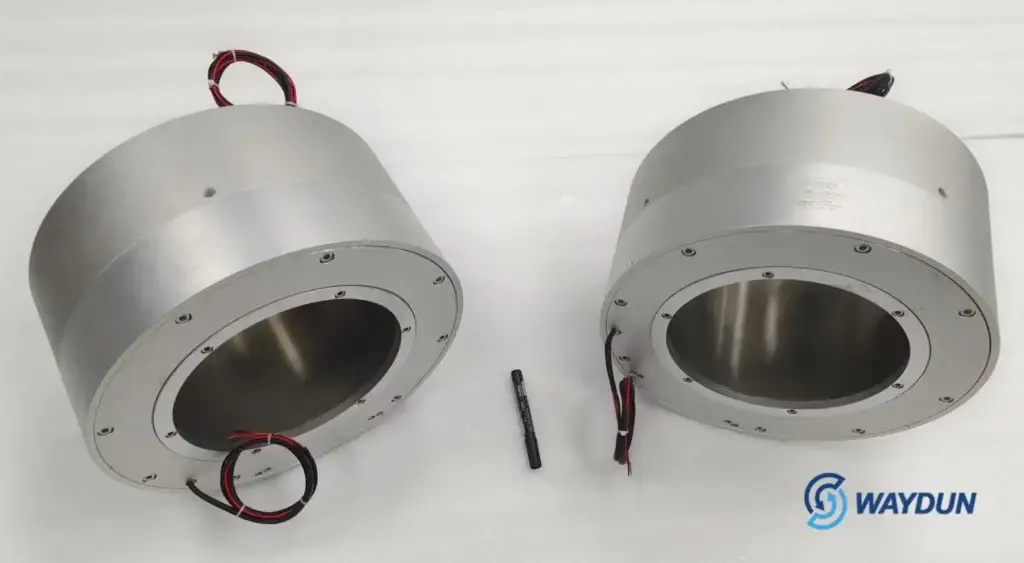
A customized electrical slip ring should be designed according to the actual application rather than simply modifying a standard product.
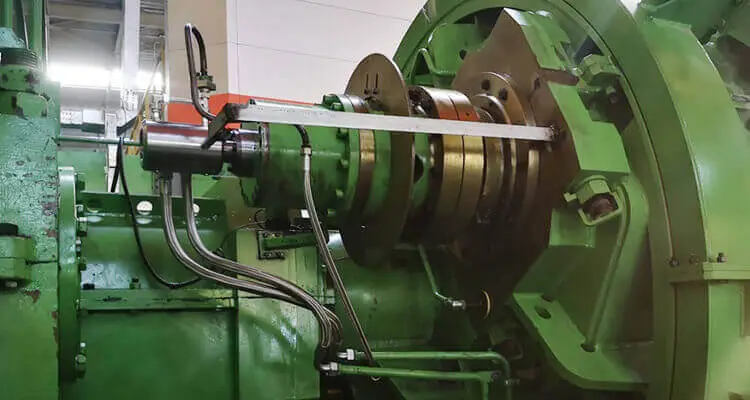
Applications such as industrial machinery, aerospace systems, energy equipment, and outdoor automation platforms often require specialized solutions to maintain reliable power and signal transmission under temperature stress.
How WayDun Technology Manufacturing High-Temperature Slip Ring?
Heat-resistant Material Selection
The conductive ring/brush uses high-temperature resistant alloys (such as silver alloys and nickel-based alloys), and the insulation layer uses heat-resistant materials such as ceramics and polyimide to avoid aging and failure at high temperatures.
Sealing and Protection Design:
Metal or welded sealing structures are used to prevent the intrusion of high-temperature gases and dust. Some models are filled with inert gas to reduce oxidation.
Low Friction and Heat Dissipation Optimization:
The contact pairs use a low-friction coefficient combination, coupled with heat dissipation grooves and a thermally conductive substrate, to reduce the combined effects of frictional heat generation and high temperatures.
WayDun Technology’s high-temperature resistant slip rings employ a special design that effectively isolates the internal main structure from high-temperature interference, resulting in more stable operation and a longer lifespan.
Conclusion: What We Can Do Before Select High Temperature Slip Ring
For high-temperature industrial environments, engineers should select a high temperature slip ring designed with suitable insulation materials, contact structures and thermal resistance capabilities.
Frankly speaking, we do not have many high-temperature slip ring cases, the highest temperature slip ring we made is only 300℃. Based on past experience, if you want to use slip rings in high-temperature environments, we recommend installing a heat-insulating protective cover on the outside of the slip ring.
Another common scenario is that the gas/liquid rotary joint operates under high-temperature conditions, and the slip ring integrated with it is also exposed to a high-temperature environment. In this case, the slip ring and rotary joint can be designed separately and use independently.