
A rotary union is a rotating mechanical device that transfers fluid or gas while maintaining a sealed connection. Depending on the application, a rotary union may transfer hydraulic oil, coolant, water, compressed air, steam, thermal oil, vacuum, or other compatible media. Rotary unions are widely used on machine tools, rotary tables, spindles, rollers, drums, hydraulic fixtures, industrial processing equipment and automated machinery.
A conventional pipe connection cannot accommodate continuous rotation without twisting or damaging the connection. A rotary union provides the transition between the fixed and rotating sides while maintaining fluid flow.
Its actual performance depends on more than pressure rating alone. Sealing technology, rotational speed, flow rate, temperature, fluid compatibility, alignment, hose loading, drainage, installation accuracy, and duty cycle all affect service life.
Table of Contents
ToggleWhat Is a Rotary Union?
A typical assembly contains a rotating element, a stationary housing, sealing elements, bearings, depending on the design there will be one or more internal flow passages.
The rotating side connects to a machine shaft, spindle, roller, drum, rotary table or other rotating component. The stationary side connects to the fluid supply or return system. During operation, the rotor turns with the machine while the housing remains stationary. The sealing system must maintain the fluid boundary while allowing relative movement between the two sides.
Terminology varies among manufacturers and industries. Some suppliers use rotary union as the main product name, while others use rotary joint, rotating union or swivel joint.


Why Is a Rotary Union Important?
A rotary union allows a rotating machine to receive or discharge fluid continuously without stopping rotation.
For example, a hydraulic fixture may need pressure and return flow. A CNC spindle may need continuous coolant delivery at high speed. A pneumatic rotary table may need several independent air circuits while the table rotates.
Without a suitable rotary union, the fluid connection would have to rely on flexible tubing that moves with the machine. Continuous twisting, bending, and movement can limit service life and create problems with tubing fatigue and routing.
A properly selected rotary union provides:
- continuous fluid transfer;
- controlled sealing between rotating and stationary components;
- independent passages when multiple circuits are required;
- compatibility with the machine’s pressure, temperature, speed, and working medium;
- a practical connection between fixed piping and rotating equipment.
The rotary union may be physically small, but it is really useful.
How Does a Rotary Union Work?
The basic working principle can be summarized as:
Sealing + Rotation + Flow-Path Distribution
All three functions have to work at the same time.
Sealing System
The sealing system keeps the working medium inside the intended flow path while allowing relative movement between the rotating and stationary components.
Depending on the design and application, a rotary union may use O-rings, rotary seals, mechanical seals, balanced seals, pressure-assisted sealing arrangements, or other sealing technologies.
The seal selection is influenced by:
- working medium;
- pressure;
- temperature;
- rotational speed;
- lubrication conditions;
- required service life.
Dynamic sealing is particularly important because the sealing surfaces must maintain contact while moving relative to each other.
A seal that performs well under static pressure may not perform the same way during rotation.
Rotor and Housing
The rotor connects to the rotating machine component.
The housing remains stationary and connects to the fixed fluid system.
The relative movement between the rotor and housing is the reason a rotary union needs specialized sealing and mechanical design.
The exact structure varies from one rotary union to another. Some designs use bearing-supported rotors, while others use different support arrangements. Therefore, construction should always be evaluated from the manufacturer’s specific design rather than assumed from the product name.
Bearings
Bearing-supported rotary unions use bearings to support the rotating assembly and maintain the required relationship between the rotor and housing.
The bearing system has to tolerate the actual radial and axial loads created by the application, including loads transmitted through connected piping, fixtures, or rotating components.
Not every rotary union uses the same bearing arrangement, and some designs may use bearingless configurations.
Flow Passages
The internal passages determine how fluid enters and leaves the rotating equipment.
A simple rotary union may contain a single passage.
More complex designs may contain two, four, six, eight, or more independent circuits.
Multi-passage rotary unions are useful where several independent circuits must cross the same rotating interface while remaining separated.
Typical applications include hydraulic fixtures, machine-tool rotary tables, pneumatic rotary systems and automated equipment.
Drainage and Leakage Path
Some rotary unions include a dedicated leakage or drain path.
The purpose is not necessarily to imply a product failure. In some sealing arrangements, a controlled leakage path or drain port forms part of the overall sealing design.
The drain system must remain open and correctly routed.
A blocked drain, excessive back pressure, or an incorrectly positioned drain line can allow fluid to accumulate around the housing or bearing area.
Types of Rotary Unions
Rotary unions can be classified by working medium, number of passages, sealing technology, pressure, temperature, speed, and mounting arrangement.
- According to different media used, it can be divided into heat transfer oil rotary unions, steam rotary unions, water rotary unions, compressed air rotary joints, etc.
- According to the number of channels, it can be divided into single-pass rotary joint, double-pass rotary joint and multi-pass rotary joint.
- According to different sealing forms, they can be divided into mechanical sealing rotary joints and hydraulic sealing rotary joints.
- According to different pressures, they can be divided into low-pressure rotary joints, medium-pressure rotary joints and high-pressure rotary joints.
- According to different temperatures, it can be divided into normal temperature rotary joints and high temperature rotary joints.
- According to different rotation speeds, they can be divided into low-speed rotary joints and high-speed rotary joints.
Definition and Distinction of Rotary Unions
Rotary Union vs. Rotary Joint
The terms rotary union and rotary joint are often used interchangeably for fluid transfer between stationary and rotating components.
The difference is often more about industry terminology and product naming than about a universal technical definition.
Some manufacturers use “rotary joint” heavily in steam, thermal-oil, and process applications, while others use “rotary union” more broadly across hydraulic, coolant, pneumatic, and industrial applications.
For SEO and technical communication, it is useful to understand both terms and use the one that matches the application naturally.
Rotary Union vs. Swivel Joint
A swivel joint generally emphasizes relative rotation between two connected components.
A rotary union adds the requirement of maintaining a controlled fluid connection during that rotation.
The terminology overlaps in industrial applications, but the selected component still needs to be checked for:
- pressure;
- media compatibility;
- rotational speed;
- seal technology;
- number of passages;
- drainage;
- mechanical loads.
The product name alone is not enough to determine suitability.
Rotary Union vs. Slip Ring
A rotary union and a slip ring transfer different types of media.
A rotary union transfers fluid or gas.
A slip ring transfers electrical power, signals, or data across a rotating interface.
Some machines require both.
For example, a rotating system may need:
- hydraulic actuation;
- compressed air;
- electrical power;
- sensor signals;
- encoder feedback;
- Ethernet or other communication.
In those cases, a fluid rotary union and electrical slip ring can be integrated into one rotating interface.
This combination is particularly relevant to:
- robotics;
- machine tools;
- wind turbines;
- rotating platforms;
- automated fixtures;
- packaging machinery.
Supplier WayDun Technology already provide fluid-and-electrical rotary integration combining rotary unions with slip-ring functions.
Rotary Union vs. Rotary Coupling
If the fluid or gas being transmitted, then Rotary Union and Rotary Coupling are essentially interchangeable.
If the rotational power (torque) being transmitted, then Rotary Coupling refers to a mechanical coupling, whose function is to connect the driving shaft and the driven shaft, allowing for a certain degree of angular, radial, or axial misalignment between them while transmitting torque.

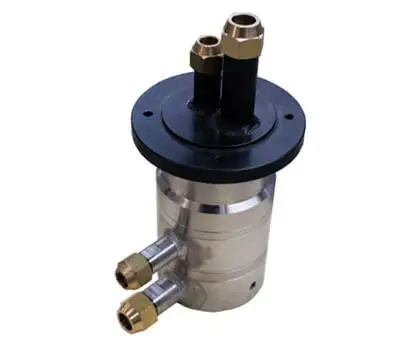
Rotary Union Selection Guide
The rotary union should be selected from the complete machine operating envelope rather than from one specification.
Before selecting a model, determine:
- working medium;
- number of independent passages;
- flow rate;
- operating pressure;
- maximum pressure;
- operating temperature;
- rotational speed;
- duty cycle;
- shaft and housing connection;
- mounting dimensions;
- torque and mechanical loads;
- installation space;
- drainage requirements.
Current industrial selection guidance similarly treats media, flow paths, pressure, temperature, speed, loads, and environmental conditions as part of the selection process.
Rotary Union Installation Guide
Installation quality can have as much influence on service life as product selection.
A correctly rated rotary union can still fail early if it is installed with excessive runout, contaminated piping, rigid hose connections, incorrect thread direction, or improper anti-rotation support.
Clean the Fluid Path Before Installation
New rollers, pipes, and internal channels may contain:
- welding residue;
- metal chips;
- rust;
- machining debris;
- sealant fragments.
If these particles enter the sealing area, they can damage the sealing surfaces or cause abnormal operation.
The original installation guidance recommends flushing or purging the roller and piping using a suitable medium before installation. The choice of cleaning medium depends on the operating system.
Use Appropriate Filtration
A suitable filter should be installed upstream of the rotary union where contamination control is required.
The filtration level must be matched to the rotary union and fluid system.
The original field material gives approximately 40–60 μm as an example filtration range. This should not be treated as a universal specification for every rotary union.
High-speed machine-tool applications may require tighter filtration depending on the sealing system, coolant quality, and equipment requirements.
Use Flexible Hoses
A flexible hose helps isolate the rotary union from pressure pulsation, equipment vibration, and small alignment changes.
The hose should not:
- pull on the housing;
- push against the housing;
- twist the rotary union;
- exceed its minimum bend radius;
- remain permanently deformed.
Rigid piping should not be used where it transfers excessive loads into the rotary union.
Your original installation material explicitly warns against directly connecting the rotary union to rigid piping because external pipe loads can increase vibration and friction.
Why Does a Rotary Union Leak When Rotating?
A piece of equipment is shut down and pressure-held for ten minutes, leaving the area around the rotary joint clean; however, as soon as the spindle is accelerated, water droplets are swirling around the outer casing. The initial reaction on-site is often, “The seal is broken.” The equipment is removed, replaced, and restarted, but leaks reappear shortly after. This is because static testing only proves that the seal is functioning correctly in a stationary state; rotation reveals the true effects of coaxiality, hose stress, the condition of the sealing surface, and drainage conditions.
No leaks when stationary do not equate to normal operation during rotation.
The core issue of rotary joints “leaking only when rotating” is not simply “aging seals,” but rather that rotation exposes runout, lateral forces, friction, and drainage problems that are not visible during static inspection. Locating the leak first, then measuring runout, subsequently checking the hoses and operating conditions, and only then assessing the internal seal is typically faster and less prone to rework than immediately replacing parts.
Common Rotary Joint Faults
Fault Diagnosis: From Abnormal Signals to Root Cause Resolution.
Rotary joint failures often show early warning signs. Timely detection of abnormalities can prevent major downtime.
| Fault Phenomenon | Typical Cause | Inspection Steps |
| External leakage (liquid leakage / gas leakage) | Damaged DNA seal + degraded TOC sealing surface; worn auxiliary sealing ring | 1. Observe leakage location (end face / connection port); 2. Measure shaft runout (≤ 0.03 mm is normal) |
| Large pressure fluctuation | Flow channel blockage, valve core stuck | 1. Check filter pressure difference (> 0.5 Bar requires cleaning); 2. Disassemble and check for foreign objects (such as rubber fragments) |
| Abnormal temperature rise (>70°C) | Bearing lack of oil, poor installation alignment | 1. Use infrared thermometer to locate heat source; 2. Use laser alignment instrument to check concentricity (allowable error ≤ 0.05 mm) |
| Abnormal noise and vibration | Bearing pitting, rotor imbalance | 1. Use vibration meter inspection (effective value > 7.1 m/s requires shutdown); 2. Check bearing clearance (> 0.03 mm indicates wear) |
| Medium cross-flow | Isolation seal failure, flow channel partition corrosion | 1. Check whether the water contains bubbles (gas-liquid cross-flow); 2. Inspect flow channel integrity with an endoscope |


Rotary Union Industry Applications
- Steel Industry: Continuous casting (ladle turrets), hot rolling, cold rolling rotary swivel (uncoilers, annealing furnaces).
- Machine tool manufacturing: Rotary joints are mainly used for spindle center cooling in machine tools. Other applications include hydraulic chuck drive, rotary table media supply, and rotary spindle cooling. Recommended dual-channel rotary joint products.
- Oil and Gas Industry: Coiled tubing units and fracturing trucks (Wash Pipes, Cementing rotary joints withstanding up to 10,000 PSI).
- Rubber Industry: Banbury mixers (water/thermal oil) on counter-rotating rolls.
- Plastics Industry: Extruders, cooling rolls, blown film lines, and injection molding.
- Wind Power Industry: Hydraulic rotary unions and pitch slip rings for blade angle adjustment.
- Semiconductor Industry: CVD/PVD equipment, CMP wafer polishing heads, and high-speed dicing saws.
- Paper Industry: Papermaking dedicated rotary unions and steam condensate systems.
- Construction Machinery: Hydraulic rotary unions allow fluid transfer through rotating machinery structures. Typical products include excavator rotary union and hydraulic swivel joint for crane.
How to Custom a Rotary Union?
Standard rotary unions do not fit every machine.
A custom design may be required when the application includes:
- limited installation space;
- unusual shaft dimensions;
- non-standard mounting;
- many fluid passages;
- mixed media;
- high rotational speed;
- high pressure;
- special materials;
- vacuum;
- electrical integration;
- unusual duty cycle.
Custom development should begin with the operating envelope rather than with the desired external dimensions alone.
Important application information includes:
- working media;
- operating and maximum pressure;
- operating and maximum temperature;
- flow rate;
- rotational speed;
- shaft dimensions;
- housing dimensions;
- passage count;
- port orientation;
- mounting method;
- mechanical loads;
- duty cycle;
- environmental conditions.
Frequently Asked Questions (FAQs)
Q: How do I repair a leaking rotary union?
A: Repairing a leaking rotary union starts with diagnosing the root cause rather than blindly replacing the seals. First, determine if the leak originates from the housing drain port or the thread connections. Check for shaft runout, ensure the flexible hoses are not applying lateral tension to the housing, and verify the media cleanliness. If the internal dynamic seals are severely scored or the bearings are compromised by fluid ingress, it is usually more cost-effective to replace the entire unit or use official rotary union replacement parts rather than attempting a DIY seal swap.
Q: Why is my rotary joint leaking only when it spins?
A: Static non-leakage does not guarantee normal rotary operation. When stationary, a slight eccentricity might be absorbed by the seal’s elasticity. However, once rotating, this eccentricity translates into periodic wobbling, causing the mechanical sealing surfaces to momentarily separate and fling out the media. Always measure the installation runout with a dial indicator.
Q: Are there custom rotary union manufacturers for specific applications?
A: Yes. While standard off-the-shelf models cover many applications, industries like semiconductor manufacturing, specialized packaging machinery, and wind turbines often require custom rotary unions. Manufacturers can customize the number of passages, seal materials, housing dimensions, and even integrate electrical slip rings (electro-pneumatic combinations) to meet unique operational demands. Cases of custom rotary union from WayDun Technology
Q: Can a rotary union transfer hydraulic oil and air at the same time?
A: Yes. Some multi-passage rotary unions are designed to transfer different media through independent passages. Proper isolation and drainage are important.
Q: Can a rotary union be combined with a slip ring?
A: Yes. A rotary union can be integrated with an electrical slip ring when a rotating system requires both fluid transfer and electrical power, signal, or data transmission.
Conclusion
Choosing, installing, and maintaining the right rotary union is essential for the longevity and efficiency of your rotating equipment. By understanding the structural principles, strictly following installation protocols, and maintaining clean fluid systems, you can significantly reduce downtime and extend the lifespan of your components. If you need further formatting assistance, visual references, or want to review the original diagrams, you can refer to Hangzhou WayDun Technology. For specialized requirements, always consult with experienced rotary union suppliers to ensure you get the exact specifications your application demands.