
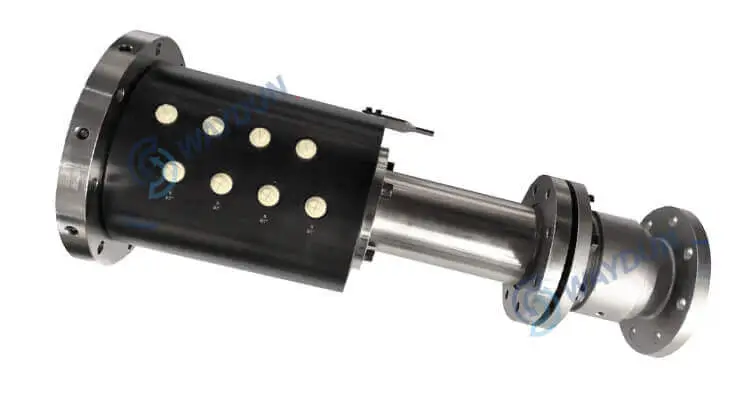
A rotary union selection involves more than matching pressure, temperature, and speed ratings. A unit may meet every catalog specification and still fail prematurely because of fluid contamination, excessive seal friction, internal tube vibration, or incorrect installation.
The key is to evaluate the complete operating conditions, including how different parameters interact and how the rotary union will be installed. This guide written by WayDun Team covers the main factors to consider when selecting a rotary union for industrial equipment, from seal material and internal tube design to connection types and mechanical constraints. Read more Rotary Union Complete Guide.
1. Start with the Actual Operating Conditions
The first step in rotary union selection is to establish the full operating range rather than rely solely on maximum ratings.
Pressure, temperature, and rotational speed are interdependent. High temperatures can affect seal preload and material stability. Higher speeds increase frictional heat, while pressure fluctuations and water hammer can disturb the sealing interface. Fluid viscosity and lubricating properties also influence seal wear.
A rotary union rated for a certain maximum pressure and RPM should not automatically be assumed to handle both limits simultaneously.
When evaluating a rotary union datasheet, confirm:
- Normal and maximum operating pressure, including pressure spikes.
- Normal and peak fluid temperature.
- Maximum and minimum continuous rotational speed.
- Fluid type, flow rate, and number of passages.
- Rotation direction and start-stop frequency.
- Whether the equipment operates continuously or intermittently.
Minimum continuous speed is often overlooked. Many manufacturers specify maximum RPM but provide little information about low-speed operation. In applications such as drying rollers and thermal processing equipment, prolonged operation at very low speeds may prevent a stable lubricating film from forming between the seal faces. Confirm the minimum allowable continuous speed and recommended seal combination with your rotary joint supplier before selecting a model.
2. Choose Seal Materials for the Actual Fluid
Rotary union seal material selection must account for fluid chemistry, temperature, lubrication, and possible contamination. Choosing an elastomer based only on its maximum temperature rating is not sufficient.
NBR can swell or lose strength when exposed to certain solvents and fluid additives. FKM offers good resistance to many oils and chemicals but is not compatible with every chemical mixture. EPDM is commonly used in hot-water and steam applications but is generally unsuitable for mineral oils.
Mechanical seal faces require similar attention. Silicon carbide against carbon graphite is a common combination for water, steam, and thermal oil applications where suitable lubrication conditions exist. Silicon carbide against silicon carbide may be considered for certain abrasive media, although alignment and lubrication become particularly important. Spring-energized PTFE seals can be considered for applications involving frequent thermal cycling.
Fluid contamination is another important source of failure.
For example, when cooling water enters a thermal oil circuit during maintenance, corrosion products and other solid particles may circulate through the rotary union. These particles can progressively damage the sealing faces, turning minor leakage into a major failure.
A paper-machine application provides another example. A rotary union operating at 1.6 MPa and 120 RPM experienced severe seal damage despite operating within its nominal pressure and speed ratings. The underlying problem was inadequate material compatibility with the sulfur-containing medium.
Before ordering a rotary union, confirm the complete fluid composition, including additives, moisture, gas, and solid particles. For contamination-sensitive systems, upstream filtration and proper isolation procedures should also be considered. Contact us to customized rotary union
3. Check the Combined Pressure and Speed Limits
One of the most common mistakes in selecting a rotary union is treating maximum pressure and maximum rotational speed as independent operating limits.
Seal friction depends partly on contact pressure and sliding velocity. Their relationship is commonly evaluated using the PV value:
PV = p × v
Where p is the seal-face contact pressure and v is the sliding velocity. For a rotating sealing face:
v = π × Dm × n / 60
Here, Dm is the mean seal diameter in meters and n is rotational speed in RPM. The contact pressure must be defined according to the seal manufacturer’s design method; it should not automatically be replaced by system line pressure.
When pressure and sliding velocity increase together, frictional heat can exceed the sealing system’s ability to dissipate it. This can lead to accelerated wear, thermal deformation, loss of lubrication, and eventual seal failure.
Therefore, rotary union pressure and speed ratings must be checked together. Request the WayDun Technology manufacturer’s permissible operating envelope or PV limits for the specific seal configuration. If the datasheet only provides separate maximum values, confirm whether they are achievable simultaneously during continuous operation.
A suitable rotary union for high-pressure service may require reduced rotational speed, while a high-speed application may need a different seal design or lower operating pressure.
4. Select the Correct Siphon Tube Configuration
For rotary unions used on rollers and rotating cylinders, the choice between a stationary siphon tube and a rotating siphon tube affects mechanical stability and service life.
Stationary siphon tube: The tube remains fixed while the roller rotates around it. This design is relatively simple and suitable for many short rollers and moderate-speed applications. However, a long unsupported tube behaves like a cantilever. Roller movement, vibration, and thermal expansion can cause deflection and excessive radial loading.
Rotating siphon tube: The tube rotates with the roller. It is often considered for longer rollers and continuous steam or thermal oil applications. However, excessive tube length can still cause deflection and runout.
For long internal tubes, segmented construction and intermediate support bushings can help control radial movement and axial displacement.
A failure on a textile tenter-frame line illustrates the importance of this detail. An excessively long internal tube without adequate intermediate support developed significant rotational movement. The resulting cyclic loads affected the bearing and sealing assembly and eventually damaged the housing and threaded connection.
When selecting a rotary union for a long roller, evaluate tube length, diameter, support arrangement, and operating speed together.
5. Choose the Right Connection Type and Rotation Direction
The connection between the rotary union and the rotating equipment must match the machine’s actual movement.
Thread direction is important for continuously rotating equipment, but conventional left-hand and right-hand thread selection rules apply only to unidirectional operation with threaded connections.
For rollers that frequently reverse direction, threaded connections may gradually loosen under repeated torque changes. A flange or other positively locked connection designed for bidirectional operation is generally preferable.
The internal tube connection must also be secured against loosening during rotation.
For high-speed rotary union applications, concentricity and connection accuracy become increasingly important. Where precise alignment is required, a locating shoulder or precision flange may be more suitable than relying on a tapered pipe thread alone.
Always specify the exact thread standard, such as NPT, BSPP, or metric, rather than relying on nominal size alone.
6. Consider Installation and Mechanical Loads
A rotary union is designed to transfer fluid between stationary and rotating equipment. It should not be expected to support external piping loads or compensate for poor machine alignment.
Flexible hose connections: Rigid pipework can transfer thermal expansion, vibration, and installation errors directly to the rotary union housing. Use appropriately rated flexible hoses between the stationary piping and the union. Avoid excessive tension, twisting, or side loading.
Anti-rotation support: The anti-rotation pin or arm prevents the housing from rotating with the shaft. However, the mounting arrangement may need to accommodate small movements caused by runout or thermal expansion. Follow the manufacturer’s mounting requirements instead of rigidly locking the housing in every direction.
Alignment and runout: Excessive shaft runout or angular misalignment causes uneven seal-face loading and accelerates localized wear. Measure radial and face runout during installation. For high-speed applications, confirm the required rotor dynamic balance and alignment limits with the manufacturer.
Many premature rotary union failures originate from installation conditions rather than defects in the union itself. These factors should be evaluated before the model is finalized.
7. Rotary Union Selection for Different Applications
The best rotary union configuration depends on the operating conditions of the equipment.
Application | Main selection considerations |
Steam compatibility, seal material, siphon tube configuration, and thermal expansion | |
Thermal oil roller systems | High-temperature seals, tube support, continuous-duty capability, and fluid cleanliness |
Textile tenter frames | Long-tube stability, intermediate support, and secure connections |
Reversing rollers | Bidirectional operation and flange connections |
Low-speed continuous equipment | Minimum continuous RPM and seal lubrication |
High-speed machine tool spindles | PV limits, concentricity, rotor balance, and coolant compatibility |
Vacuum and dry-gas applications | Suitable low-lubrication seal design and purge or isolation requirements |
These are initial selection guidelines. Final specifications must be checked against the actual machine design and operating envelope.
8. What Information Should You Provide to a Rotary Union Manufacturer?
Incomplete operating information often leads to unsuitable models, repeated technical changes, and premature failures after installation.
When requesting a rotary union quotation or a custom design, provide the following details:
Selection category | Required information |
Fluid | Medium type, composition, additives, contamination |
Pressure | Normal pressure, maximum pressure, pressure fluctuations |
Temperature | Normal and peak temperature, thermal cycling |
Speed | Maximum RPM, minimum continuous RPM |
Flow | Required flow rate, passage diameter, number of passages |
Motion | Continuous rotation, intermittent operation, or reversing |
Internal structure | Stationary or rotating siphon tube, tube length, support requirements |
Connection | Thread or flange, thread standard, connection dimensions |
Installation | Shaft runout, alignment, hose arrangement, anti-rotation support |
Sealing | Seal-face materials, elastomers, lubrication, purge requirements |
For replacement rotary union selection, supplying the existing model number, product drawing, and installation dimensions is also helpful. For a new application, equipment drawings and a description of the operating cycle allow the manufacturer to assess the complete configuration.
Conclusion
Reliable rotary union selection starts with the operating conditions, not the product catalog. Fluid compatibility, pressure-speed interaction, seal design, internal tube stability, and installation loads all affect service life.
A rotary union that meets the basic pressure and temperature ratings may still be unsuitable for the actual application. The better approach is to identify the most likely failure mechanisms and address them before finalizing the design.
Whether selecting a standard rotary union or developing a custom rotary union solution, providing complete operating and installation information is essential. It helps manufacturers like Hangzhou WayDun Technology recommend a configuration that fits the machine, reduces premature leakage, and minimizes unplanned downtime.