
What Engineers Need to Know Before a Industrial Slip Ring Fails?
A electrical slip ring failure rarely happens suddenly.
In most industrial applications, problems usually appear gradually. Operators may first notice unstable signals, occasional communication errors, abnormal temperature rise or unexpected equipment behavior. These early signs often indicate that the electrical contact, insulation structure, or signal transmission path inside the slip ring has already changed.
After years of manufacturing industrial slip rings, one thing becomes clear: finding the cause early is far less expensive than dealing with equipment downtime after failure occurs.
However, harsh industrial environments create three recurring challenges:
- Conductive contact wear and contamination;
- Electromagnetic interference affecting signal quality;
- Moisture intrusion causing insulation degradation.
Understanding these failure patterns helps engineers diagnose problems faster and select more suitable solutions.
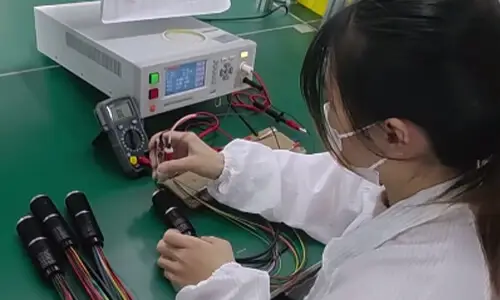
Fault 1: Signal Transmission Stuttering/Distortion, Abnormal Contact Resistance
Typical Symptoms
Control signal delays during equipment operation; stuttering and distortion in high-definition image/high-frequency data transmission; misalignment of industrial robot joints; and excessive fluctuations in precision detection data.
Multimeter testing shows that the industrial slip ring contact resistance fluctuation exceeds 5mΩ (normal ≤5mΩ). Disassembly reveals wear scratches and dust accumulation on the conductive ring and uneven brush wear.
Core Causes
Long-term high-speed friction between the brushes and conductive rings causes damage and metal debris accumulation.
Industrial dust intrudes through the sealing gaps, forming a contact isolation layer.
Improper brush pressure adjustment or material mismatch with operating conditions further amplifies contact resistance fluctuations.
Diagnosis and Solution
Diagnosis:
Signal testing shows a significant increase in transmission error rate during rotation. Combined with multimeter data on contact resistance fluctuations and the wear and dust marks found after disassembly, the diagnosis is confirmed.
Solution:
① Replace with the same model original precious metal brushes (gold/silver alloy preferred for precision transmission),
② Thoroughly clean the conductive ring surface of debris and dust with anhydrous ethanol,
③ Replace aged seals and install a dustproof cover,
④ Readjust brush pressure to ensure uniform contact (normal pressure 0.1-0.3N, conforming to equipment specifications).
Electrical Slip Rings Maintenance Practices and Troubleshooting
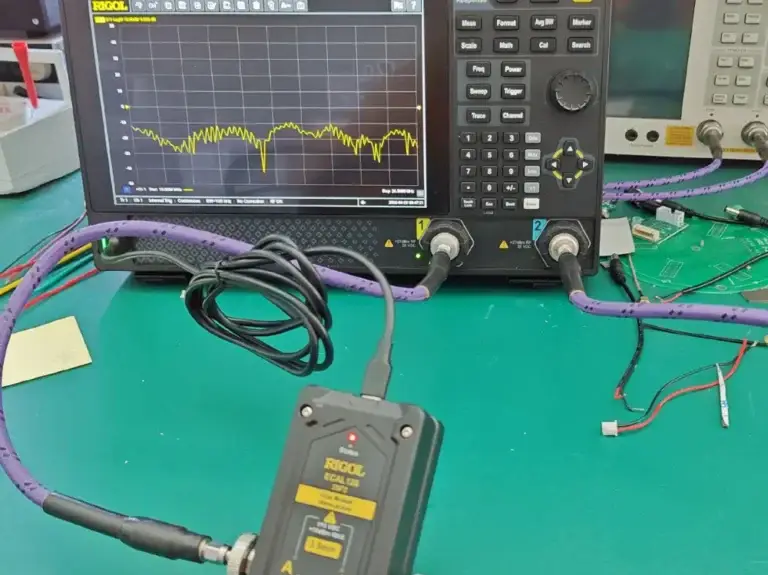
Fault 2: High-Frequency Signal Attenuation/Crosstalk, Significant Electromagnetic Interference
Typical Symptoms
High-frequency signal attenuation exceeding 10dB above 1GHz (normal ≤3dB);
Crosstalk between different pathways (e.g., control signals interfering with detection data);
The fault is more severe when the equipment is near electromagnetic sources such as frequency converters and high-voltage cables;
Significant interference noise is detected at the slip ring output using a spectrum analyzer.
Core Causes
Insufficient shielding design of the electric slip ring’s internal signal path, unable to resist external electromagnetic interference;
Insufficient insulation spacing between pathways, leading to signal coupling crosstalk;
Contact noise generated by unstable contact between the conductive ring and brushes, which amplifies electromagnetic interference and further deteriorates the signal.
Diagnosis and Solution
Diagnosis:
Comparing the signal spectra at the input/output terminals of the electrical rotary connector using a spectrum analyzer reveals additional noise at the output and a significant drop in high-frequency signal amplitude;
the fault is alleviated after moving away from the electromagnetic source, confirming an electromagnetic interference fault.
Solution:
① Replace the industrial slip ring with one featuring enhanced shielding (e.g., a metal shield, differential signal path design);
② Add an electromagnetic shielding sleeve to the outside of the rotating slip ring and optimize wiring—separate signal cables from power cables and high-voltage cables (spaced ≥ 30cm);
③ Inspect the internal insulation layer of the collector ring, replace it if damaged;
④ Install an amplifier in the high-frequency signal path to compensate for transmission attenuation.
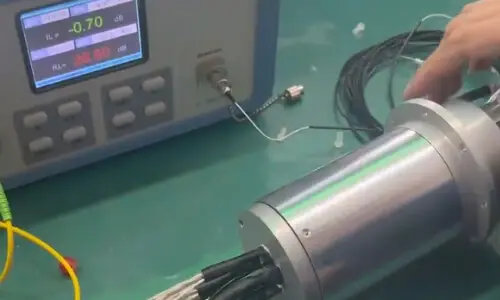
Fault 3: Degraded Insulation Performance, Accompanied by Leakage/Signal Crosstalk
Typical Symptoms
Leakage alarm occurs after power-on; casing becomes live.
Severe crosstalk between different circuits causes equipment malfunction. Megohmmeter testing shows insulation resistance between collector ring circuits and between the circuits and the casing is below 1000MΩ (normal ≥1000MΩ).
After disassembly, white condensation and green rust are visible on the conductive rings, the insulation layer is softened due to moisture.
Core Causes
Humid environment or condensation seeps in through the sealing gaps, causing the insulation layer to age due to moisture.
Long-term moisture exposure leads to oxidation and corrosion of the conductive rings, damaging insulation performance.
Failure of the sealing structure allows moisture to accumulate, causing the fault.
Diagnosis and Solution
Diagnosis:
Using a 500V range megohmmeter, if the insulation resistance is lower than the standard value, and combined with the humid operating conditions and condensation and rust marks after disassembly, the fault can be diagnosed as insulation degradation caused by moisture erosion.
Solution:
① Disassemble the collector ring and dry it in a drying oven at a low temperature (≤60℃ to avoid damaging the insulation layer);
② Polish the oxidized and rusted conductive rings. If the rust depth exceeds 0.1mm, replace the slip ring directly;
③ Replace the original seals, apply a moisture-proof coating to the outer shell, and install a mini dryer to optimize the environment;
④ For high humidity conditions, select a moisture proof slip ring with a protection rating ≥IP65.
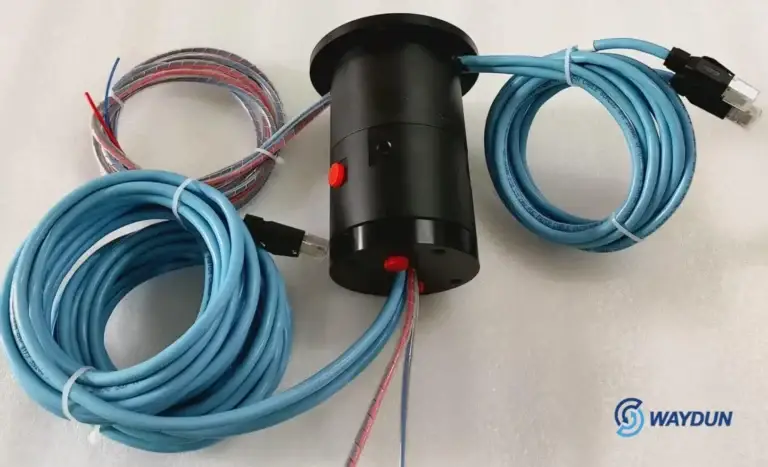
Final Thoughts: Reliability Comes From Understanding Failure Mechanisms
A electrical slip ring is a small component, but its failure can affect the entire rotating system. They are widely used in construction machinery, industrial robots, inspection systems, automation equipment and other rotating platforms where signals, high-frequency data and multiple power channels must be transferred with minimal loss.
Learn common industrial slip ring electrical failures, engineers can reduce unexpected downtime and extend the service life of rotating electrical systems.
Frequent premature slip ring failures suggest it’s time to consider alternatives or switch suppliers, rather than just replacing failed units. Consult with industrial slip ring suppliers in China to discuss these issues—whether through fully integrated assemblies connector or upgraded protection-rated units.
Frequently Asked Questions
What are the most common causes of slip ring failure?
The most common causes of slip ring failure include contact wear, dust contamination, electromagnetic interference and moisture-related insulation degradation. These problems usually appear as unstable signals, increased contact resistance or reduced insulation resistance.
How can you diagnose a faulty slip ring?
Engineers typically diagnose slip ring problems by checking contact resistance, insulation resistance, signal stability and internal component conditions. Electrical measurements should be combined with physical inspection of brushes, conductive rings and sealing structures.
Why does a industrial slip ring lose signal during operation?
Signal loss may result from increased contact resistance, brush wear, electromagnetic interference, poor shielding design or unstable electrical contact between the brush and conductive ring.