
When engineers specify a slip ring, electrical and mechanical requirements come first: current, voltage, signal type, rotational speed, and operating environment. Material selection and surface treatment are what determine whether those requirements are met reliably over millions of revolutions.
This guide explains how to match conductive ring materials, brush types, and surface treatments to real application requirements—and why manufacturing quality ultimately determines long-term performance.
Quick answer: There is no single best slip ring material. The optimal combination of ring material, brush type, and surface treatment depends entirely on your electrical requirements, environment, and target service life. The sections below explain how each factor is evaluated.
Table of Contents
ToggleWhy Electrical Requirements Drive Material Selection
A common misconception is that there is a universal best material for slip ring contacts. In practice, the optimal material depends entirely on the application. The same number of circuits can require completely different material combinations depending on operating conditions.
Before selecting any material, engineers evaluate:
- Signal type (power, analog, encoder, Ethernet, RF)
- Rotational speed
- Temperature and humidity range
- Exposure to moisture, chemicals, or corrosive agents
- Required service life and maintenance interval
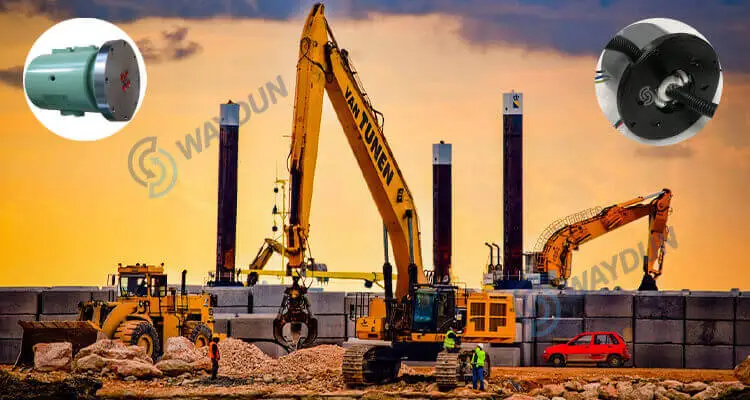
The table below shows how these requirements vary across typical applications:
Application | Primary Engineering Concern |
High current, dust, long maintenance interval | |
Low contact resistance and minimal electrical noise | |
Signal integrity over tens of millions of rotations | |
Corrosion resistance and environmental protection | |
High-speed test spindle | Wear characteristics and thermal stability |
Conductive Ring Materials: Selection Guide
The conductive ring is the primary current-carrying component. Its material influences conductivity, wear behavior, contact resistance, and long-term stability.
Material | Typical Use | Key Advantage |
Copper alloy / Brass | High-current power channels | High conductivity, cost-effective |
Bronze (Cu-Sn) | General industrial power rings | Better wear resistance than brass |
Gold alloy (Au-Ag/Pd) | Low-level signals, data transmission | Extremely low noise, oxidation-proof |
Silver alloy (Ag-Cu) | High-conductivity signal & power | Highest conductivity of common metals |
Stainless steel | Housings, shafts, harsh environments | Excellent corrosion resistance |
Copper Alloys and Brass
Copper alloys are the most widely used material for power transmission channels because of their high conductivity and excellent machinability. For circuits carrying 10 A or more, copper alloys offer the best balance of conductivity, manufacturability, and cost. Because copper is more susceptible to oxidation than precious metals, surface treatment is especially important for long-term stability.
Bronze (Cu-Sn)
Bronze is preferred when additional mechanical strength and wear resistance are required. Compared with brass, it offers better wear resistance, higher mechanical strength, and more stable performance under repeated contact—making it a reliable choice for general industrial applications where durability outweighs the need for maximum conductivity.
Gold Alloys (Au-Ag/Pd)
When signal integrity is the primary concern, gold alloys are the preferred choice. They provide extremely low contact resistance, excellent oxidation resistance, stable signal transmission, and low electrical noise. Because gold is expensive, it is typically reserved for signal channels rather than high-current power circuits.
Silver Alloys (Ag-Cu)
Silver alloys offer very high electrical conductivity and are used when minimizing resistance is critical. Silver’s main limitation is tarnishing over time, particularly in sulfur-rich or contaminated environments. Environmental conditions must be evaluated carefully during design.
Stainless Steel
Stainless steel is rarely selected as a primary conductive path due to its relatively low electrical conductivity. It is commonly used for housings, shafts, structural components, and corrosion-resistant assemblies—particularly in marine and offshore equipment when combined with appropriate passivation treatments.
The Contact System: Ring and Brush Must Be Evaluated Together
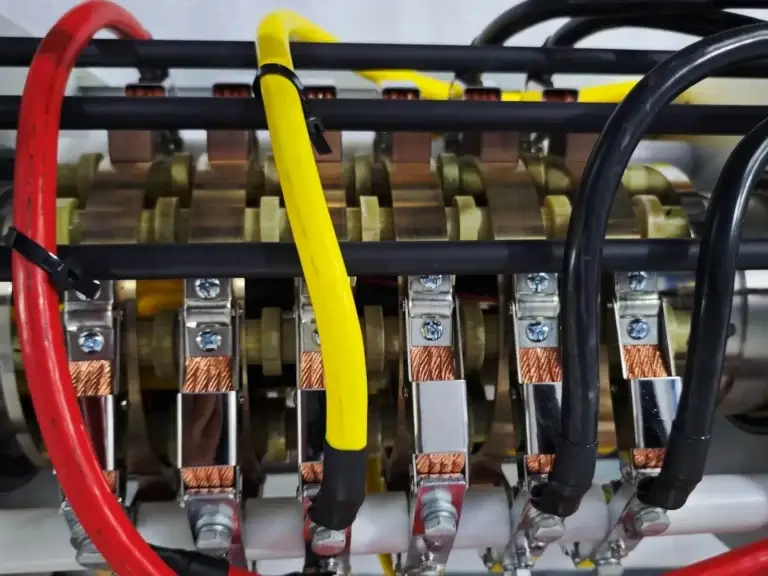
Many engineers focus exclusively on the conductive ring material while overlooking the brush—the other half of the electrical interface. A slip ring is a continuously moving tribological system where friction, wear, lubrication, and electrical conduction occur simultaneously. Even high-quality materials produce poor results if combined incorrectly.
This is why two slip rings with identical copper alloy rings can have completely different service lives. The difference often lies in the brush material, contact pressure, surface finish, or manufacturing quality—not the ring itself.
When evaluating the contact system, engineers consider:
- Contact force and friction coefficient
- Wear rate of both surfaces
- Heat generation
- Electrical noise characteristics
- Expected maintenance interval
Selecting the Right Slip Ring Brush Material
There is no universal brush material. Selection depends on four factors: current capacity, signal quality requirements, rotational speed, and target service life.
Carbon and Graphite Brushes
Carbon-based brushes are the preferred solution for medium- and high-current applications. Their key advantage is self-lubrication: a microscopic transfer film forms on the contact surface during operation, reducing friction and extending brush life. Carbon brushes tolerate high currents and perform reliably in continuous-duty applications.
Typical applications include:
- Wind turbine slip rings
- Industrial generators and heavy machinery
- Cable reels and metallurgical equipment
Carbon brushes generate more electrical noise than precious metal alternatives and are less suitable for sensitive data transmission.
Precious Metal Fiber Brushes
When signal quality takes priority over current capacity, precious metal fiber brushes are the preferred choice. Unlike conventional solid brushes, fiber brush systems use numerous fine contact wires, creating multiple simultaneous contact points, lower contact resistance, reduced electrical noise, lower contact force, and improved signal stability.
Typical applications include:
- Industrial Ethernet and encoder systems
- HD video transmission
- Medical equipment and precision inspection machines
Slip Ring Brush Type | Best For | Limitation |
Carbon / Graphite | High current, continuous duty | Higher electrical noise |
Precious metal fiber | Signal integrity, low-noise data | Lower current capacity |
Surface Treatment: The Few Micrometers That Determine Performance
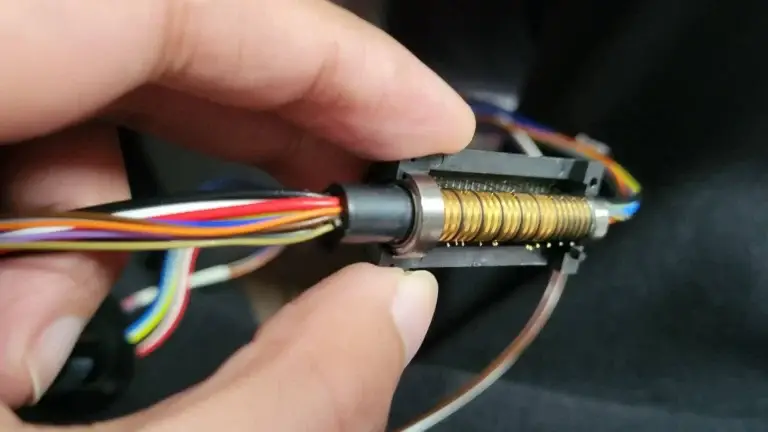
If material selection defines the foundation of a slip ring, surface treatment determines how that material performs during everyday operation. Contact plating is typically only a few micrometers thick, yet that thin layer governs electrical contact, mechanical wear, friction, oxidation resistance, contact stability, and electrical noise. Experienced manufacturers devote as much attention to plating quality as to the base material itself.
Hard Gold Plating
Hard gold plating is the standard choice for low-current signal circuits where stable contact resistance is essential. It offers greater wear resistance than soft gold while maintaining excellent conductivity. Primary applications include industrial Ethernet, encoder signals, medical electronics, aerospace, and precision sensors.
Soft Gold
Soft gold provides slightly higher conductivity than hard gold due to fewer alloying elements, but its lower hardness makes it more susceptible to wear. It is typically selected for applications with low contact pressure or limited mechanical cycling.
Silver Plating
Silver offers outstanding electrical conductivity and is often specified for higher-current power transmission in indoor industrial environments where oxidation can be controlled. Silver tarnishes naturally over time; while tarnish does not always cause immediate failure, it can gradually increase contact resistance under unfavorable conditions.
Nickel Underlayer
Gold cannot be plated directly onto copper without a barrier layer. Without nickel, copper atoms gradually diffuse through the gold coating during operation, eventually allowing oxidation to reach the contact surface. A nickel underlayer prevents this diffusion and is one of the most important elements in ensuring long-term reliability—though it is invisible to the end customer.
Rhodium
Rhodium offers exceptional hardness and wear resistance and is reserved for demanding applications such as aerospace systems, precision instrumentation, and high-cycle environments where its performance advantages justify the higher cost.
Why “Gold-Plated” Is Not Enough Information?
Many suppliers advertise gold-plated contacts as a quality indicator. From an engineering standpoint, this description provides little useful information. What actually matters is:
- How thick is the gold layer?
- Is the plating uniform around the entire circumference?
- What is the finished surface roughness?
- Has adhesion been verified through standardized testing?
- Is the plated surface free from contamination?
Without these details, “gold-plated” is a marketing description rather than a performance specification.
Four Manufacturing Details That Separate High-Quality Slip Rings
Plating Thickness Uniformity
Uneven plating creates uneven wear. Excessive circumferential variation produces localized wear zones that cause premature failure regardless of coating quality. Reliable manufacturers measure and control thickness uniformity across the full circumference of the ring.
Adhesion
A well-plated surface has no value if it separates from the substrate. Coating adhesion should be verified through standardized testing before products enter production.
Surface Roughness
A rough contact surface increases friction, brush wear, and electrical noise. An excessively smooth surface reduces lubrication retention. The optimal finish is carefully controlled rather than simply made as smooth as possible.
Cleanliness
Residual polishing compounds, machining oils, flux residues, or metallic particles all shorten service life. Cleaning is one of the final manufacturing steps and directly affects long-term reliability, particularly in humid or contaminated environments.
Conclusion
Electrical specifications define the performance requirements that a slip ring must meet. Material selection and surface treatment are the engineering tools used to achieve those requirements reliably over the product’s operating life.
Rather than searching for the best material or plating process in isolation, experienced engineers evaluate the entire contact system: conductive rings, brush materials, surface treatments, insulating components, and manufacturing quality working together to deliver stable electrical performance, controlled wear, and predictable service life. How to design, selection and manufacturing rotary connectors?
Manufacturing details—plating uniformity, adhesion, surface finish, cleanliness, and contact material compatibility—often have a greater influence on long-term performance than the choice of material alone.
Need help specifying a slip ring for your application? Our engineering team evaluates your electrical specifications, mechanical constraints, and reliability goals to recommend the right material and surface treatment combination for your operating conditions.