
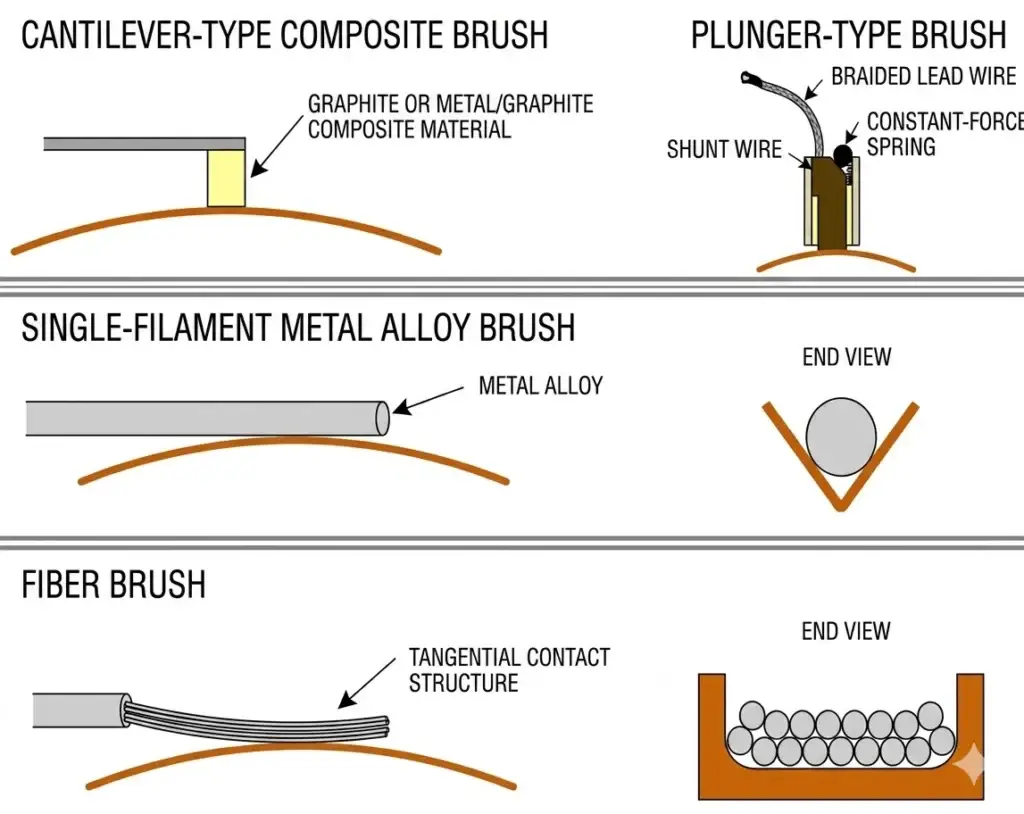
Slip ring types guide by form factors, trade-offs, transmission types, operating environments, and a structured decision framework for engineers, procurement specialists, and system designers.
Table of Contents
Toggle1. Why Slip Ring Type Selection Matters
The phrase “electrical slip ring” — also rendered as rotary electrical interface, rotary electrical connector, collector ring, or electrical rotary joint — covers a surprisingly wide family of devices. At one end sits a fingertip-sized capsule slip ring handling two signal circuits at microamp levels in a laboratory instrument. At the other end, a torso-sized wind turbine collector assembly passes several hundred amperes of excitation current continuously for two decades in a nacelle exposed to North Sea weather. Both are slip rings. Neither would function correctly in the other’s role.
The commercial market has converged on six principal form factors, each engineered to address a specific combination of constraints: axial space, radial space, shaft access, current level, data rate, operating environment, and maintenance tolerance. When hybrid and specialized types are included — high-current variants, IP-rated waterproof assemblies, pneumatic/hydraulic rotary unions — the full taxonomy extends to twelve distinct types. Understanding what defines each type, and what trade-off it accepts in exchange for its defining advantage, is the foundation of sound device selection.
A note on selection philosophy before diving in: the goal is not to identify the highest-performance type in any absolute sense. It is to identify the type whose defining characteristics best match the demands of the application at hand, with acceptable trade-offs everywhere else. The technically superior device that is physically incompatible with the installation envelope, or priced above the application budget, is not the right answer. The slip ring type determines the design space; the specification within that type determines the outcome.
2. The Main Slip Ring Types: A Complete Taxonomy
Slip ring classification is not a single linear hierarchy. The types below can be grouped along three independent axes: by mechanical form factor (how the device is shaped and mounted), by transmission medium (what it carries), and by the operating environment it is engineered to withstand. These axes are not mutually exclusive — a through-bore slip ring can simultaneously be a high-current type, an IP68-rated waterproof type, and an Ethernet-integrated data type. Understanding this multi-dimensional taxonomy prevents the common mistake of treating the types as competing alternatives rather than potentially combinable attributes.
The table below provides a side-by-side overview of all twelve principal types. Sections 3 through 5 examine each in depth.
Type | Structure / Form | Transmission Media | Typical Current / Signal | Key Advantages | Limitations | Typical Applications | Maintenance Level | Cost Tendency |
Capsule Slip Ring | Compact cylindrical module; rings stacked axially like coins; flange or clamp mount | Power + multi-channel signals | 0.3 A–several hundred A per circuit; low-voltage signals | Widest catalog selection; shortest lead times; uniform brush wear across all circuits | No central bore; longer axially as circuits increase | PTZ cameras, packaging machines, rotary tables, cable reels | Low (brush rack slides out from one side) | Low–Medium |
Through-Bore Slip Ring | Hollow-shaft design; central bore 5–400 mm+; ring stack sits around the bore like a sleeve | Power, signals, data (hybrid); shaft / hoses / fiber pass through center | 2 A–2,000 A+ per circuit; flexible circuit count | Central passage eliminates external cable loops; modular circuit stacks; field-replaceable | Larger OD; bearing load capacity must be specified separately | Wind turbines, robotic joints, indexing tables, offshore crane turrets | Medium (modular stacks replace individually) | Medium–High |
Pancake (Flat) Slip Ring | Flat disc; rings as concentric tracks on a face; brushes press axially | Power + low-to-medium signals | Low–medium current (limited contact area per track) | Minimum axial depth of any type; fits constrained axial envelopes | Uneven brush wear (outer tracks wear faster); higher inter-circuit capacitance; contamination accumulates on face | Thin rotary stages, camera heads, pan-tilt platforms, medical bed rotation | Medium–High | Medium |
PCB Slip Ring | Conductive tracks etched on rotating PCB disc; spring probe contacts on fixed side | Low-power signals only | mA–1 A, low-voltage | Extremely compact and lightweight; very low unit cost at volume | Not for high current or harsh environments; replace-as-unit maintenance | Consumer electronics, light-duty instrumentation | Low (replace as unit) | Very Low |
Mercury-Wetted Slip Ring | Liquid mercury fills annular groove; stationary electrode contacts mercury pool — no sliding friction | Power + low-noise signals | Up to several hundred A; near-zero contact noise | Zero mechanical wear; ultra-stable contact resistance; lowest noise floor of any contact type | Freezes at −38.8 °C; EU RoHS restricted; toxic / hazardous disposal; declining new-design adoption | Legacy analytical ultracentrifuges, early CT scanner collectors, gyroscope test platforms — replacement stock only | None (no wear) but specialist disposal at EOL | High (legacy supply) |
Wireless / Contactless Slip Ring | Inductive or capacitive coupling across air gap; no mechanical contact; performance determined by coil geometry | Low power (10–50 W typical per coupler) + low-bandwidth signals | 80–90% power transfer efficiency; limited to kHz–low MHz signal bandwidth | Zero brush wear; fully sealed possible; performance identical on day one and day ten thousand | Power density orders of magnitude below contact types for same envelope; gap dimension must stay stable (bearing-dependent) | Food/pharma washdown environments, semiconductor clean rooms, low-power sensor feeds, RFID | None (no brushes) | High |
Fiber Optic Rotary Joint (FORJ) | Collimating lens couples stationary fiber to rotating fiber across precision air gap; no metal in signal path | Optical signals only (no electrical power) | 1 Gbps–100 Gbps+; 0.5–1.5 dB insertion loss typical | Gigabit-plus bandwidth; complete EMI immunity; ideal alongside high-power RF or magnetic fields | No power path (requires electrical slip ring for hybrid assembly); alignment-sensitive; optical faces need periodic cleaning | Radar pedestals, MRI gantries, naval EW systems, HD broadcast crane heads | Low–Medium (optical face cleaning every 6–12 months) | High |
Ethernet / High-Speed Data Slip Ring | Controlled-impedance electrical rings; often integrated with power circuits in same housing | Ethernet 100 Mbps–1 Gbps; CAN bus; RS-485; USB 2.0 | Return loss >15–20 dB; insertion loss <3 dB @ operating frequency | Standard industrial protocols; plug-and-play integration with PLCs and vision systems | Signal integrity degrades above ~1 Gbps on copper; careful EMI shielding required | Robotics, AGVs, CNC machines, industrial IoT | Medium | Medium–High |
High-Current Slip Ring | Large-diameter rings machined from copper billet; multiple parallel brushes per ring; active cooling optional | High-power electrical (AC or DC) | 100 A–10,000+ A; up to 480 V AC | Handles the largest power loads; robust construction; water-cooled variants available | Large, heavy; significant brush wear at high current; regular inspection required | Cranes, electric arc furnaces, wind turbine main power, marine winches | High (brush inspection every 3–6 months) | High |
Miniature Slip Ring | Sub-22 mm OD; precision thin-section bearings; fine-pitch ring insulation; gold-on-gold contact standard | Power + low-level signals | <1 A per circuit; mV-level signal | Extreme compactness; lightweight; specialist precision bearings minimize run-out | Very low current; fragile; specialist tooling; 8–12 week lead time for new custom designs | Medical robots, drone gimbals, surgical instruments, UAV payloads | Low–Medium | Medium–High |
Waterproof / IP-Rated Slip Ring | Sealed housing; dynamic lip seals or labyrinth seals at shaft entry; O-rings at housing joints; IP54–IP69K | Any transmission type (power, signal, fiber) inside sealed housing | Varies by internal circuit design | Operates in wet, dusty, corrosive, or washdown environments; IP69K for food/pharma | 20–50% larger OD than unsealed equivalent; annual seal inspection required | Offshore equipment, food processing lines, outdoor CCTV masts, marine deck machinery | Medium (seal inspection annually; dynamic seal replacement per schedule) | Medium–High |
Pneumatic / Hydraulic Hybrid | Combined rotary union (fluid passages with dynamic seals) + electrical slip ring in single concentric housing | Electrical (any) + gas / hydraulic fluid up to ~350 bar | Power/signals + pressurized fluid; seal material matched to media | Single unit replaces separate fluid swivel and electrical junction box; saves space and simplifies installation | Complex; specialized maintenance; media compatibility drives seal material selection | Injection molding machines, forestry equipment, robotic arms with pneumatic tooling | High (seal and bearing inspection; media flush schedule) | High |
Three classification dimensions to keep in mind:
- By mechanical structure: capsule, through-bore, pancake, PCB, miniature — these terms describe physical shape and mounting method.
- By transmission medium: power, signal, Ethernet/data, fiber optic, RF/coax, pneumatic/hydraulic — these describe what the device carries.
- By operating environment: waterproof/IP-rated, high-temperature, vibration-resistant, cleanroom-grade, ATEX-certified — these describe where the device operates.
3. Slip Ring Types by Mechanical Structure
Once the transmission media are defined, physical constraints — available space, mounting interface, shaft access, and maintenance access — determine which form factor is feasible.
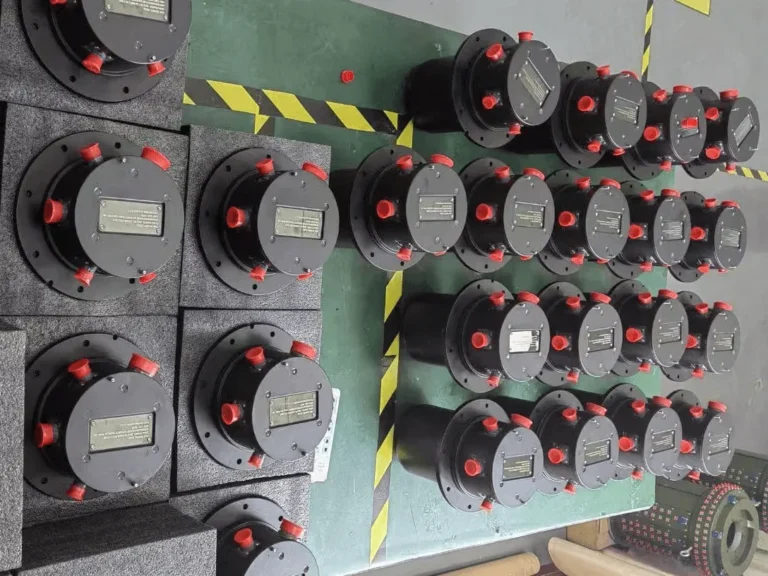
The capsule slip ring — also marketed as a barrel-type slip ring in larger format — is the industry baseline. Conductive rings are arranged axially along a cylindrical rotor body, stacked side by side like coins in a roll. Brushes press radially inward or outward against the ring surfaces, and the complete assembly fits inside a round housing that mounts by its outer diameter or by an end flange.
This geometry is the most efficient for most combinations of circuit count, current rating, and compactness. All rings share the same radius, which means all brushes run at the same linear velocity against their respective rings and wear uniformly across all circuits. Adding more circuits means extending the rotor axially — a straightforward engineering change that does not disturb existing circuits or require a larger housing diameter.
Capsule slip rings span the widest performance range of any form factor. Miniature variants — typically 12 to 22 millimeters in outer diameter — handle two to twelve signal circuits at currents from a few milliamps up to a few amps. Large-bore industrial assemblies manage forty or more circuits with individual current ratings up to several hundred amperes, supported by active cooling jackets and integrated condition monitoring. Speed capability depends heavily on brush type: standard carbon-graphite brush versions are rated to 250–600 RPM for continuous service, while metal fiber brush capsule slip rings push that ceiling to 10,000 RPM without cooling, making them suitable for machine tool spindles, industrial centrifuges, and certain generator excitation systems.
The capsule configuration is the correct default choice when no other geometric or performance constraint forces a different type. Its advantages are the widest catalog selection and shortest lead times; the most straightforward maintenance (brush replacement requires opening one side of the housing, sliding out the brush rack, and reinstalling); and the most predictable performance specification. General-purpose industrial automation, motor-driven turntables, packaging machinery, and most standard cable reel applications are natural capsule territory. The capsule type is the wrong choice only when axial depth is severely constrained, or when the application requires a shaft or media bundle to pass through the rotational center.
The pancake slip ring — also called a flat slip ring, disc-type collector, or axial slip ring — addresses the one constraint the capsule geometry handles poorly: very short axial depth. Instead of stacking rings along an axis, the pancake arranges them as concentric circular tracks on a flat disc face, similar in concept to the grooves on a vinyl record. Brushes press axially against the disc rather than radially against a cylinder. The axial dimension of the assembly is therefore determined only by the disc thickness and housing depth, not by the number of circuits — enabling a twelve-circuit assembly barely thicker than the disc itself.
The pancake geometry introduces two performance penalties that are intrinsic to the form factor and cannot be fully engineered away. The first is uneven brush wear: because ring tracks are at different radii, the outermost tracks have a larger circumference and their brushes travel faster for the same rotational speed. The assembly’s effective service life is set by the outermost ring and its brush — not the average across all circuits. On a capsule, all rings share the same radius and wear uniformly. On a pancake, the outer tracks determine the maintenance interval.
The second penalty is higher inter-circuit capacitance. Adjacent ring tracks on a flat disc face are physically closer together than rings on an equivalent capsule, separated by narrower insulating gaps. The resulting higher capacitance makes pancake assemblies less suitable for high-speed digital data transmission, where inter-circuit capacitance directly limits bandwidth and increases crosstalk. High-frequency analog signals and fast fieldbus protocols are better served by capsule or through-bore configurations.
Pancake slip rings are well matched to motorized camera heads, thin rotary stages in semiconductor wafer handling and flat-panel display inspection equipment, compact pan-tilt-zoom surveillance camera housings, and medical bed rotation mechanisms where axial clearance is designed out of the installation from the start. The pancake type is the wrong choice for high-current power circuits (where the geometry limits contact area and thermal dissipation), for high-speed digital data (where the capacitance penalty is unacceptable), or for any installation where contamination from above the disc face can accumulate on the working tracks.
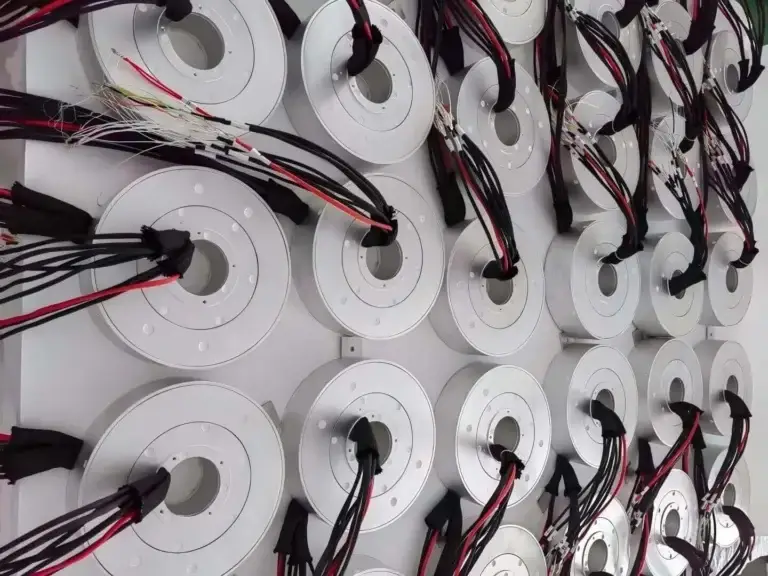
The through-bore slip ring — also described as a hollow-shaft slip ring, center-hole slip ring, or through-hole slip ring — incorporates a cylindrical passage running through the full axial length of the assembly along the rotation axis. The machine shaft, or a bundle of hoses, cables, and fluid lines, passes straight through the bore rather than coupling to the slip ring’s end face. The ring assembly sits around the shaft like a sleeve, handling its electrical connections through its own body while the shaft or media bundle runs independently through the center.
In structural terms, a through-bore slip ring is a hollow-shaft capsule ring. The ring stack, brush assembly, bearings, insulating spacers, and housing all work on the same principles as a standard capsule unit. The difference is entirely in the installation architecture: the bore changes what the slip ring can coexist with on the same rotational axis.
Rotating machinery regularly requires the same rotation axis to carry more than just electrical circuits. Robotic arms need servo motor power cables and encoder wiring alongside pneumatic supply lines for end-effector tooling. Rotary indexing tables need power for workholding fixtures and data for sensors alongside a structural shaft. Offshore crane turrets need electrical power alongside hydraulic supply for the crane drive. Pipe inspection tools need signal cables alongside the pipe being inspected, which runs down the center of the tool. Without a through-bore, all these media must be routed around the outside of the rotation axis — adding external cable loops, spiral wraps, and rotating unions that increase installation diameter and introduce additional failure points. Bore diameters in commercial through-bore slip rings run from under five millimeters in miniaturized instruments to over 400 millimeters in large industrial turrets.
The through-bore geometry places specific demands on mechanical integration that solid-shaft capsule slip rings do not share. Because the bore passes through the rotor, the slip ring’s own bearing must support the rotor relative to the stator independently of any external shaft alignment — bearing load capacity must be specified to match the radial and axial forces imposed by the machine, not just the weight of the slip ring rotor itself. For hydraulic and pneumatic lines passing through a through-bore slip ring, the combination is sometimes referred to as a rotary union with integrated electrical slip ring, though the two functions are mechanically separate within the assembly.
Through-bore slip rings dominate new industrial automation designs precisely because they maximize mechanical design flexibility. They appear in articulated robot wrist joints, CNC rotary tables, wind turbine pitch control systems, film and broadcast camera crane heads, medical imaging gantry rings, subsea ROV umbilical terminations, and military electro-optical turrets where the bore carries the optical sight line or a fiber optic bundle. In any application where the question is “how do I get all these cables and lines through the same axis,” the through-bore slip ring is the starting point of the answer.
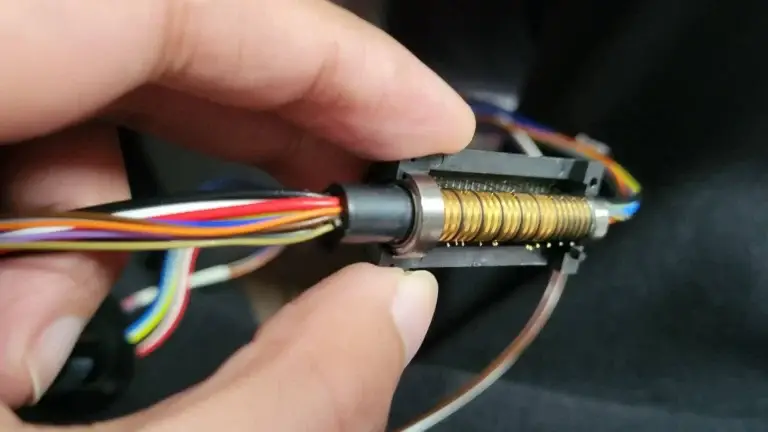
Miniature slip rings are defined by outer diameter — typically 6–22 mm — rather than by any single internal technology. They use precision thin-section bearings, chemically polished contact surfaces, and fine-pitch ring insulation to pack multiple circuits into a very small envelope. Gold-alloy brush-on-gold-ring contact is standard in miniature designs because the contact force per brush must be minimized to avoid brinelling the thin rings, and only a noble metal contact pair achieves stable low resistance at very light brush loads. Custom miniature slip rings are precision-machined components; tooling costs are significant and lead times of 8–12 weeks are typical for new designs.
IP rating per IEC 60529 defines resistance to solids (first digit) and liquids (second digit). The most relevant levels for rotating electrical connectors are IP54 (splash-resistant), IP65 (low-pressure jet), IP67 (immersion to 1 m for 30 minutes), IP68 (continuous submersion), and IP69K (high-pressure, high-temperature steam jet from all directions — the standard for food and dairy equipment). Achieving IP67 or higher requires dynamic seals at the rotating shaft entry and static O-ring seals at all housing joints, adding 20–50% to the outer diameter compared with an equivalent unsealed design.
Structural comparison by space and environment constraints:
Type | Axial Space | Radial Space | Bore Required? | IP Rating Achievable | Maintenance Access | Typical Lifespan |
Capsule | Small–Medium | Small | No | Up to IP54 | Simple — brush rack slides from one end | 20–100 million rev. (gold contacts) |
Through-Bore | Medium–Large | Medium | Yes (central bore) | Up to IP68 (sealed variants) | Moderate — modular stacks replace in field | 50–100 million rev. |
Pancake (Flat) | Very Small | Large | Optional | Up to IP54 | Moderate — disc face must be kept clean | 30–60 million rev. (outer tracks set life) |
PCB | Tiny | Small | No | IP40 typical | Replace-as-unit | 5–20 million rev. |
Miniature | Very Small | Very Small | Optional (some) | Up to IP54 | Specialist only — return to manufacturer | 20–50 million rev. |
Waterproof / IP-rated | Medium | Medium | Available | IP54–IP69K | Seal inspection annually; dynamic seal replacement | 50–100 million rev. (with seal maintenance) |
High-Current | Large | Large | Optional | IP23–IP55 | Regular — brush inspection every 3–6 months | 10–30 million rev. at rated current |
4. How to Choose the Right Slip Ring Type
Choosing between slip ring types is a process of elimination based on the application’s dominant constraint. The selection process is straightforward when approached systematically: geometric constraints first, electrical requirements second, environmental characterization third, total cost of ownership last. Each step eliminates options. What remains after all four steps is the type that fits the application — not the best-performing type in the abstract, but the right type for the specific machine being built.
Step 1: Define Transmission Requirements
List every circuit the slip ring must carry: number of power circuits and current/voltage per circuit; number of analog signal circuits and required CRV/noise level; digital protocols and required bandwidth; fiber optic or RF channels; and fluid media if a hybrid is needed. This step alone eliminates entire categories: if you need 10 Gbps data, only a FORJ or a purpose-engineered coaxial joint is viable; if you need 500 A continuous, you need a high-current design; if you need pressurized hydraulic oil, you need a hybrid rotary union.
Step 2: Define Mechanical Constraints
Determine whether a central bore is required — if yes, only through-bore or certain hybrid types qualify. Measure the available axial length and outer diameter envelope. If axial length is the binding constraint, consider a pancake type; if both are tight, a miniature or PCB type may be the only fit. Confirm the mounting interface and the direction of the electrical lead exit (axial, radial, or tangential).
Step 3: Define Environmental Requirements
Identify IP requirements based on the operating environment: outdoor or marine applications typically demand IP67 minimum; food processing requires IP69K; indoor dry automation accepts IP40–IP54. Confirm the operating temperature range — standard slip rings operate from -20 °C to +80 °C; high-temperature variants extend to +200 °C; mercury contacts freeze at −38.8 °C. If vibration or shock is significant, specify the vibration profile in g-force and frequency range. Explosive atmospheres (ATEX Zone 1 or 2) require certified designs with no ignition-capable surfaces or sparks, which limits brush and ring material choices.
Step 4: Define Commercial and Compliance Requirements
Required certifications (CE, UL/cUL, ATEX, IECEx, DNV, MIL-SPEC, FDA material compliance) may rule out off-the-shelf catalog products and require custom-certified designs. Expected production volume and unit cost target determine whether standard, semi-custom (modified catalog), or fully custom tooled designs are appropriate. Standard catalog slip rings are the right choice when requirements map cleanly to published specifications and delivery time matters. Semi-custom designs add 2–4 weeks and 15–50% cost, but cover a much wider range of interfaces. Fully custom designs are justified when no standard geometry fits, when a combination of media has no standard equivalent, or when operating conditions exceed catalog ratings.
Application-to-slip-ring-type matching reference:
Application / Industry | Recommended Slip Ring Type(s) | Key Reason |
Industrial robots / cobots | Through-bore, miniature, Ethernet-integrated | Hollow wrist joint carries servo cables + pneumatic lines through same axis |
Wind turbines (nacelle–hub) | Through-bore (high-current + data hybrid) | Main power cables and pitch control wiring pass through bore; combines power and signal in one unit |
Packaging & labeling machines | Capsule or through-bore | Continuous rotation; compact installation; standard catalog availability |
CT / MRI scanners | Hybrid FORJ + high-current electrical | High-speed image data requires gigabit optical path; zero EMI in high magnetic field |
PTZ / CCTV cameras | Capsule or miniature | Compact, low-current, continuous pan; widest off-the-shelf selection |
Radar & antenna systems | RF rotary joint + FORJ or electrical | Broadband RF feed + control signals; military variants with MIL-SPEC qualification |
Automated rotary tables (CNC) | Through-bore or high-current | Heavy tooling; fluid or pneumatic pass-through; structural shaft load through bore |
Marine / offshore deck equipment | Waterproof (IP67–68) through-bore | Saltwater corrosion resistance; dynamic sealing for washdown and spray |
Drone / UAV gimbals | Miniature or capsule | Ultra-light; small OD; multi-axis stabilization; gold contact for vibration tolerance |
Stage lighting / entertainment | Capsule or through-bore with DMX circuit | Continuous spinning; low-noise signal for DMX-512 protocol |
Electric arc furnaces | High-current (1,000–10,000 A) | Extreme amperage; water-cooled contact versions; busbar termination |
Semiconductor fab equipment | Contactless / wireless or cleanroom-grade FORJ | Zero particles; no lubrication contamination; fully sealed coupler resists washdown chemistry |
Food & beverage processing | Waterproof IP69K with hygienic seals | High-pressure steam or chemical washdown; FDA-compliant materials; sealed wireless coupler where access is restricted |
Film & broadcast camera cranes | Hybrid FORJ + through-bore electrical | HD-SDI video over fiber; power and control on electrical circuits; central cable passage |
Military electro-optical turrets | Through-bore or hybrid FORJ + electrical | Bore carries optical sight line or fiber bundle; MIL-SPEC shock/vibration qualification |
Selection checklist — parameters to confirm before requesting a quote:
Parameter | What to Determine | Why It Matters |
Number of circuits | Power circuits + signal/data circuits listed separately | Defines ring count and housing diameter — the primary driver of OD |
Current per circuit (A) | Peak and continuous operating current | Drives brush material, ring cross-section, contact area, and heat dissipation design |
Voltage (V AC/DC) | Maximum working voltage + dielectric test voltage | Determines insulation class and creepage distance between adjacent rings |
Signal type & bandwidth | Analog, digital protocol (Ethernet speed, CAN, RS-485), or optical | Low-noise vs. high-bandwidth design — different ring-and-brush or FORJ architecture |
Rotational speed (RPM) | Maximum sustained RPM + intermittent peak RPM | Affects brush wear rate, contact force design, and bearing selection (fiber brush for >3,000 RPM) |
Bore diameter (mm) | Outer diameter of cable/pipe bundle to pass through center | Determines whether through-bore type is needed and minimum bore size required |
Envelope dimensions (mm) | Max OD, max axial length, mounting flange pattern | Constrains mechanical type — pancake if axially limited; through-bore if bore needed |
IP / ingress protection | Environmental exposure: water, dust, chemicals, washdown pressure | Drives sealing design (O-ring, lip seal, labyrinth) and housing material selection |
Operating temperature (°C) | Ambient temperature + self-heating under full load | Contact material, lubricant grade, and seal elastomer selection |
Vibration / shock (g) | Shock and vibration profile per IEC or MIL spec | Bearing type, brush pre-load, and gap stability for wireless or FORJ designs |
Expected lifespan (rev.) | Total revolutions or operating hours over product service life | Brush material selection: graphite for economy; silver-graphite for current; gold-alloy for low-noise longevity |
Certifications required | CE, UL, ATEX/IECEx, DNV, MIL-SPEC, FDA material compliance | Can eliminate certain suppliers entirely or require documented custom design |
Quantity & lead time | Prototype or volume production; required delivery window | Standard catalog vs. semi-custom (modified flange/leads) vs. fully custom tooled design |
Common Failure Modes and Troubleshooting
Understanding the failure modes of each type guides both preventive maintenance schedules and field diagnosis:
- Intermittent signal dropout: Most commonly caused by excessive brush wear, contamination of the ring surface (oxidation, lubricant migration, debris), or brush chatter at high RPM. Check CRV with a milliohmmeter while rotating slowly by hand.
- Rising noise floor on signal circuits: Indicates early-stage brush wear or ring surface degradation. Gold-on-gold contacts typically show stable noise for millions of revolutions then degrade rapidly — replace the brush assembly at the first sign of increased noise.
- Thermal overload: Suggests actual current load exceeds rated value, inadequate ventilation, or a deteriorating contact that has increased resistance. Measure brush-ring contact resistance; check for localized discoloration (heat blueing) on rings.
- Seal failure and ingress (IP-rated types): Most commonly caused by O-ring displacement during installation, lip seal wear at the rotating shaft, or housing joint corrosion. Inspect seals annually in outdoor applications; replace dynamic seals per manufacturer’s schedule.
- FORJ coupling efficiency drop: Almost always caused by contamination of the optical faces. Clean with appropriate fiber connector cleaning tools; re-check insertion loss. If loss remains elevated after cleaning, inspect bearing run-out — misalignment degrades coupling efficiency.
- Wireless coupler performance drift: Caused by bearing wear increasing the air gap beyond design tolerance. Measure gap dimension; if outside specification, replace bearings before the coupler itself — the coupler is typically still functional.
- Bearing noise or vibration: Bearing failure causes increased run-out, which destabilizes brush contact and rapidly accelerates ring wear. Replace bearings at recommended intervals or upon detection of audible noise or measured run-out increase.
5. Get the Right Slip Ring for Your Application
Ready to specify a slip ring for your project? Prepare the following parameters before contacting a supplier or engineering team: number of circuits and type (power / signal / data / fiber); current and voltage per circuit; signal protocols and required bandwidth; rotational speed (RPM); central bore diameter (if required); outer diameter and axial length envelope; IP rating requirement; operating temperature range; vibration and shock profile; required certifications (CE, UL, ATEX, etc.); expected production quantity; and target delivery date. With these parameters defined, an experienced slip ring manufacturer can recommend the most appropriate standard catalog type, propose a semi-custom configuration, or scope a fully custom design — and provide dimensional drawings, CAD models, or engineering samples for integration validation.
Please check here, if you want to know about electrical swivel design, selection and manufacturing.
Frequently Asked Questions
How do you choose the right slip ring?
The selection process has four steps: (1) list every circuit the slip ring must carry and its electrical requirements; (2) define geometric constraints (bore required? axial vs. radial space?); (3) specify environmental requirements (IP rating, temperature, vibration, certifications); (4) assess commercial constraints (delivery, quantity, budget). Mapping these against the taxonomy in Section 2 narrows the field to one or two candidate types; a manufacturer’s engineering team validates the final specification. As a practical rule: start with a capsule if no other constraint forces a different type. Move to through-bore if a central passage is needed. Move to pancake if axial depth is the single binding constraint. Move to FORJ if data rate exceeds ~1 Gbps or EMI immunity is non-negotiable. Move to wireless if zero wear in a sealed environment outweighs the power density limitation.
What are the main types of slip rings?
The twelve principal types are: capsule (barrel-type), through-bore (hollow-shaft), pancake (flat-disc, axial), PCB, mercury-wetted (liquid metal contact), wireless/contactless (inductive), fiber optic rotary joint (FORJ), Ethernet/high-speed data, high-current, miniature, waterproof/IP-rated, and pneumatic/hydraulic hybrid. These are not mutually exclusive: a single assembly can simultaneously be a through-bore type, a high-current type, an IP68 waterproof type, and an Ethernet-integrated type.
Which slip ring type is best for Ethernet, USB, or high-speed data?
For 100 Mbps to 1 Gbps Ethernet (EtherCAT, PROFINET, EtherNet/IP): a dedicated Ethernet slip ring with controlled-impedance circuits is the standard solution — specify return loss >15–20 dB and insertion loss <3 dB. For USB 2.0 (480 Mbps): a USB-integrated slip ring works if the total electrical length (cable plus slip ring) stays below 5 meters. For USB 3.0 (5 Gbps): active repeater electronics are required, or use an Ethernet slip ring plus USB-over-Ethernet adapter. For 10 Gbps and above: only fiber optic rotary joints (FORJs) or purpose-engineered coaxial structures are practical. The bandwidth ceiling for copper-contact slip rings is approximately 1 Gbps before signal integrity constraints become severe.