
Table of Contents
Toggle1. What Is an Electrical Slip Ring?
Every engineer who designs rotating equipment eventually hits the same problem: how do you keep power flowing and signals moving to a part that never stops turning? Feed wires directly to a spinning shaft and they will wrap, chafe, and eventually snap. Limit rotation to less than 360 degrees and the machine design bends around that constraint. Neither option is satisfying, which is why the electrical slip ring — also known as a rotary electrical connector, collector ring, or rotating electrical joint — exists.
Article for Help Engineers to Know Slip Ring Well
The device creates a continuous, stable electrical bridge between a stationary structure and a rotating one. Current and signals cross that bridge in either direction, through unlimited full-circle turns, without cables twisting or joints degrading. The concept traces back to the late 1800s, when the first alternating-current generator designers needed a way to feed excitation current into spinning rotor windings. The mechanism they settled on — a metal ring on the rotor, a carbon brush pressing against it from the fixed frame, a spring holding the two together — remains the functional core of virtually every slip ring built today.
What has changed over 130-plus years is not the principle but the precision. Modern applications demand far more than early power generation ever did. Offshore wind turbines push hundreds of amperes through the rotating interface for decades with minimal maintenance access. CT scanners stream more than a gigabit of imaging data per second across a gantry spinning at three revolutions per second. Collaborative robot arms route motor drives, encoder feedback, and fieldbus signals through every continuous-rotation joint, with breakaway torque budgets so tight that brush spring pressure has to stay below the arm’s collision-detection threshold. In each case the slip ring is the silent enabler — the component that makes unrestricted rotation possible without a single tangled wire.
This article examines the device from the inside out: what each internal component does, what materials it is made from and why, and how the complete assembly transfers electrical power and signals across the rotating interface. A companion article covers the different form factors and slip ring types available on the market and the criteria for choosing between them.
2. Internal Structure: Component by Component
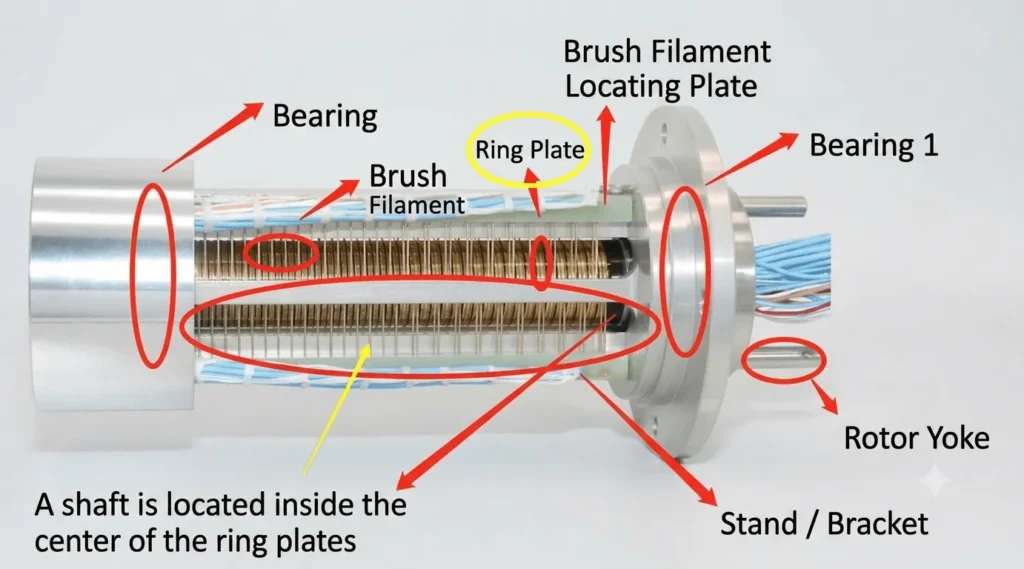
Lift the housing off a slip ring assembly and the layout inside is more orderly than the outside suggests. The shell — typically a short aluminum or stainless steel cylinder — gives nothing away. Internally, the device organizes around two functional layers: a stack of conductive metal rings and an array of brush contacts. Every other component in the assembly exists to keep those two layers in stable, precise contact while one of them rotates continuously.
2.1 Rotor and Stator: The Two Mechanical Halves
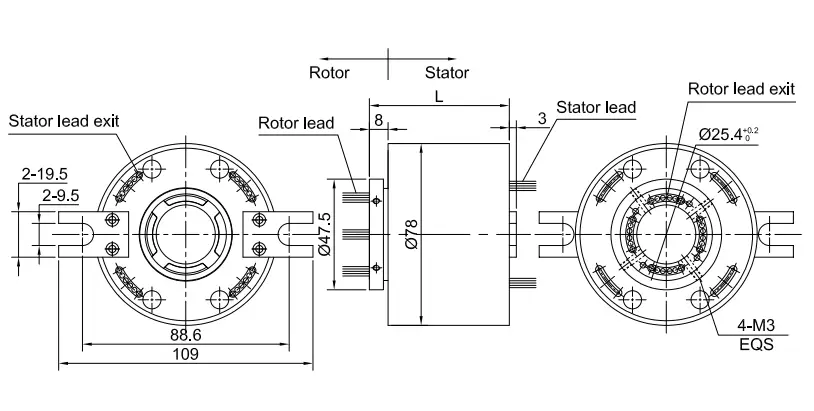
A slip ring divides into two physically distinct sections that are mechanically separate but electrically connected. The rotor is the rotating half — it couples to the machine shaft or turntable and turns with it, carrying the conductive ring stack as it goes. The stator is the fixed half — it bolts to the machine frame, holds the brush contact array, and provides the stable terminal block where the fixed-side wiring connects back to the power supply or control system.
In the standard configuration, the conductive rings mount on the rotor and the brush holders sit in the stator. The rings sweep past the stationary brushes with every revolution, and the current path stays unbroken throughout. An alternative arrangement puts the rings on the stator and lets the brushes rotate with the shaft — electrically equivalent, and occasionally the better mechanical fit for cable reel designs or servo turntables where routing the fixed wiring inward to a central hub is simpler. The contact mechanics, wear rates, and electrical performance are identical in both configurations.
2.2 Conductive Rings: Rotating Current Carriers
The conductive rings are precision-machined annular metal tracks encircling the rotor shaft. Each ring is a closed, unbroken loop — one ring equals one electrical circuit. A twenty-four-circuit slip ring carries twenty-four rings stacked axially along the rotor body, each one separated from its neighbors by an insulating spacer. Lead wires run internally through the hollow rotor core, connecting each ring to its corresponding output terminal on the load side — the rotating camera head, motor winding, sensor array, solenoid valve, or whatever the application requires.
Ring material is chosen to match the current level and the noise tolerance of the circuit it serves. Copper alloys dominate in power-carrying applications: high conductivity, good machinability, and enough mechanical toughness to handle the erosion that heavy current density imposes on the contact surface. Silver-plated and gold-plated ring tracks step in for signal-level circuits where surface stability matters more than raw current capacity. Gold is especially effective — it resists oxidation almost completely, forming only a nanometer-thin stable layer rather than the thicker resistive films that develop on copper or silver over time. That surface stability keeps contact resistance low and predictable over years of continuous operation, which is why gold-plated ring tracks are the standard in medical imaging equipment, precision instrumentation, and high-frequency data circuits.
One counter-intuitive detail: the ring surface develops a polished circular wear track over the first weeks of operation, as the brush tip traces the same path with every revolution. This wear track typically produces lower and more stable contact resistance than a freshly machined surface, because microscopic roughness is smoothed away and the effective contact area increases. Slip ring contact performance often measurably improves during the running-in period and then stabilizes — a behavior that manufacturers account for in factory-test baselines and that engineers should factor into commissioning acceptance criteria.
2.3 Brush Contacts: The Stationary Side of the Interface
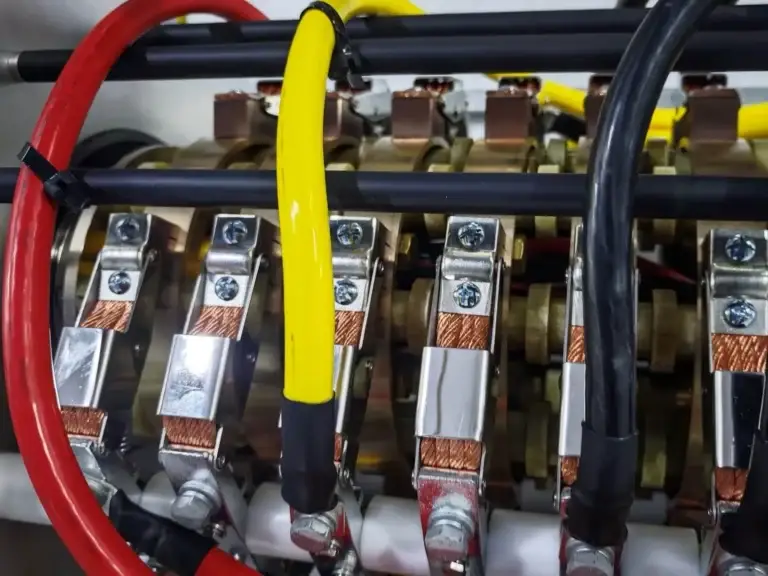
Brushes are the stationary electrical contacts that press against the outer surface of the spinning rings. Each brush block is spring-loaded against one ring, completing one circuit. The spring does more than maintain contact: it compensates for gradual brush material loss over time, keeping contact pressure — and therefore contact resistance — within a stable design window as the brush block wears shorter. A spring calibrated too light allows the brush face to chatter and arc as surface irregularities pass beneath it, generating electrical noise and pitting the ring track. A spring calibrated too heavy drives pressure above the design limit, accelerating both brush consumption and ring surface erosion.
Brush material selection is one of the highest-leverage decisions in slip ring design. The main options span a clear performance hierarchy:
Carbon-graphite is the standard grade for industrial power circuits. It is naturally self-lubricating — graphite layers shear easily along crystal planes, depositing a thin transfer film on the ring surface that smooths the contact and reduces friction. Carbon-graphite handles high current densities, costs less than any alternative, and has a decades-long track record. The trade-off is higher contact resistance and noisier electrical output compared to metal-based brushes — acceptable in most power circuits, problematic in sensitive signal circuits.
Silver-graphite composite improves both contact resistance and noise performance. Tribology research has established that silver content around 70 percent by weight achieves the best practical balance: low contact voltage drop, manageable wear rate, and a noise floor clean enough for most industrial signal circuits. Silver-graphite is the standard choice when the application needs better signal integrity than carbon can reliably deliver but does not justify the cost of precious-metal contacts.
Gold-alloy and precious-metal fiber contacts are specified for the most demanding signal circuits — thermocouple feeds, precision encoder outputs, CT scanner data links, low-level sensor chains. Contact resistance is at its minimum, the noise floor is the lowest achievable with a solid-contact design, and the surface chemistry on gold-plated rings under precious-metal brushes is stable and reproducible across a wide range of operating conditions.
The multi-fiber brush deserves separate mention. Instead of a solid contact block, it presents a bundle of hundreds of fine metal filaments — each around 50 to 100 micrometers in diameter — to the ring surface simultaneously. Contact load distributes across all those parallel paths, sharply reducing localized pressure on both brush and ring. At high rotational speeds where a solid brush would periodically lose contact and generate arcing, the compliant fiber bundle conforms to the ring surface and maintains continuous contact. Fiber brush technology is now standard for applications running above roughly 3,000 RPM — industrial centrifuges, radar pedestal drives, high-speed generator excitation systems — where solid-contact brushes would wear out too quickly or introduce unacceptable noise.
2.4 Insulating Spacers: Isolation and Structural Support
Between every adjacent ring pair sits an insulating spacer — a precision ring machined from a high-performance polymer. PEEK, glass-filled nylon, and high-temperature epoxy laminates are the most common choices, selected for their combination of high dielectric strength, dimensional stability under thermal cycling, and chemical resistance to the solvents, cutting fluids, and cleaning agents found in industrial environments. These spacers serve two simultaneous functions: preventing electrical leakage or arcing between adjacent channels, and forming the mechanical backbone of the ring stack by holding each ring in precise axial alignment under vibration and thermal expansion.
Material grade matters at elevated temperatures. A spacer that softens and creeps under sustained heat will allow rings to migrate axially, changing brush contact geometry and introducing cyclic contact pressure variations that appear in signal circuits as noise. Specifying PEEK over standard nylon in thermally demanding installations — near engines, inside nacelles, in process heating enclosures — is a straightforward precaution that meaningfully extends service life.
2.5 Bearings: Precision Determines Signal Quality
Precision bearings support the rotor shaft and govern its concentricity relative to the stator. This matters more than it might initially seem. Even a few micrometers of shaft runout — radial eccentricity as the rotor turns — translates directly into cyclic variation in brush-to-ring contact pressure. Those pressure pulses appear in signal circuits as periodic noise spikes, synchronized to shaft rotation frequency and its harmonics. The pattern is easy to identify on an oscilloscope but genuinely damaging to any circuit where the signal-to-noise budget is tight.
High-quality slip ring assemblies use sealed precision deep-groove ball bearings pre-loaded to eliminate axial play. The seals prevent bearing lubricant from migrating into the brush chamber — grease contamination on the ring surface raises contact resistance sharply and can trigger the thermal escalation sequence described in Section 4. Bearing grade is not a specification luxury; in any application carrying precision signals, it is a direct determinant of the achievable noise floor.
2.6 The Outer Housing: Structure and Environmental Seal
The outer housing ties the stator frame together and provides the mounting interface to the machine. Its second function — often undervalued until a field failure focuses attention on it — is environmental protection. The housing is the boundary between the sensitive contact interface inside and the real-world environment outside.
Protection level is specified using the IEC 60529 IP rating system. IP40 covers basic indoor installations in clean environments. IP54 is the common industrial floor standard, tolerating splashing water and limited dust ingress. IP65 provides full dust exclusion and resistance to directed water jets — adequate for most outdoor and washdown installations. IP67 and IP68 address temporary and continuous water immersion respectively, and are standard for marine deck equipment, subsea tooling, and exposed outdoor installations.
A consistent lesson from field experience: environmental contamination causes more premature slip ring failures than mechanical wear in the majority of real installations. Conductive metal dust bridging brush chambers, oil mist from nearby bearing seals coating the ring surface, coolant penetrating a degraded housing seal — these failure modes are faster and less predictable than normal brush wear. Selecting the IP rating appropriate for the actual installation environment, rather than the minimum that the nominal design intent allows, is one of the most reliable ways to extend field service life.
Table 1: Internal Component Summary
Component | Typical Material | Primary Function | Main Failure Mode |
Conductive rings | Copper alloy / silver-plated / gold-plated | Carry current on rotating side | Surface film build-up; erosion |
Brush contacts | Carbon-graphite / silver-graphite / fiber | Transfer current across interface | Wear; chatter; spring fatigue |
Insulating spacers | PEEK / glass nylon / epoxy laminate | Channel isolation; axial alignment | Thermal creep; chemical attack |
Bearings | Sealed deep-groove ball bearings | Rotor support; runout control | Fatigue; lubricant contamination |
Outer housing | Anodized aluminum / stainless steel | Mechanical frame; IP protection | Seal degradation; corrosion |
3. How the Slip Ring Transfers Power and Signals
With the structure in view, the operating principle is straightforward to trace. A slip ring works on continuous sliding contact: one conductor rotates, another stays fixed, and current crosses between them at every point of contact. Sustaining that contact reliably — without letting resistance drift or noise creep into the signal band — across millions of revolutions in real-world conditions is where the engineering lives.
4.1 Rotational Speed
Speed is the master variable: it drives brush wear rate, heat generation at the contact interface, bearing fatigue accumulation, and the susceptibility of the contact to bounce and arcing. Standard commercial slip rings are rated for 250 to 600 RPM continuous duty, covering the large majority of industrial applications. Metal fiber brush technology extends this to 10,000 RPM without active cooling. Add forced-air or oil-mist lubrication and the ceiling rises to 20,000 RPM. Custom designs for high-speed generators and turbine test equipment have reached 60,000 RPM, though at those speeds rotor dynamics and thermal management dominate the design rather than contact chemistry.
4.2 Current, Voltage, and Insulation
Each ring-brush circuit is rated for a maximum continuous current — the level at which joule heating at the contact interface reaches thermal equilibrium within the material’s limits. Standard catalog power circuits run to 500 A per ring; custom designs for industrial drives and electroplating equipment extend into the kiloampere range with active cooling and large-area contact geometry. Dielectric integrity between circuits is verified by a 500 VDC or 1,000 VAC hi-pot test, with insulation resistance values above 100 megohms at rated voltage for standard grades and above 1,000 megohms for precision signal assemblies.
4.3 Environmental Protection
The IP rating defined in IEC 60529 is one of the most consequential specification choices, and one of the most commonly under-specified. IP40 suits clean indoor environments. IP54 covers most industrial floors. IP65 is the minimum for outdoor or washdown installations. IP67 and IP68 address temporary and continuous immersion for marine and subsea use. Selecting the rating that matches the real installation environment — rather than the idealized design intent — is often the single largest factor in determining how long a slip ring lasts in the field.
4.4 Signal Bandwidth and Protocol Support
Modern rotating machinery increasingly demands that slip rings carry high-speed digital protocols alongside conventional power circuits: Industrial Ethernet at 100 Mbps or 1 Gbps, CANopen, Profibus DP, EtherCAT, and in some cases analog RF signals at megahertz frequencies. These requirements impose constraints on distributed capacitance, inductance, and characteristic impedance across the ring-brush interface that go well beyond simple resistance and current ratings. Dedicated high-frequency slip ring assemblies treat each RF channel as a coaxial transmission line, managing signals up to 3 GHz, 18 GHz, and 30 GHz for radar, ultrasound, and communications applications.
Parameter | Standard Range | High-Performance Range | Design Note |
Rotational speed | 250 – 600 RPM continuous | Up to 60,000 RPM (custom) | Fiber brushes needed above ~3,000 RPM |
Current per circuit | Signal mA to 500 A catalog | Up to 7,500 A custom | Scale contact area with current |
Insulation resistance | >100 MΩ standard grade | >1,000 MΩ precision grade | Test at full rated voltage |
IP protection | IP40 indoor baseline | IP65 / IP67 / IP68 | Match to real environment, not intent |
Signal bandwidth | DC to 100 kHz standard | Up to 30 GHz RF types | FORJ preferred above ~1 Gbps |
5. Conclusion
The electrical slip ring is one of those engineering components that sits at an unlikely intersection: a device simple enough to sketch on a napkin — ring, brush, spring — and complex enough in its detailed execution that the difference between a well-specified unit and a poorly chosen one can be measured in years of service life and thousands of hours of unplanned downtime.
The electric slip ring assembly structure analysis in this article points to five variables that determine whether a slip ring will perform reliably in a given application: rotor and stator geometry (which configuration suits the machine layout); ring and brush material (which governs contact resistance, noise floor, and maintenance interval); bearing grade (which sets the achievable noise floor in precision signal circuits); housing IP rating (which is often the deciding factor in field service life); and contact resistance trend (which is the monitoring metric that actually predicts remaining life). Get these five right and the slip ring does its job without being noticed — which is exactly what it is designed to do.