
Abstract
Conductive slip rings are precision power transmission devices used to transfer images, data signals, and electrical power between stationary and rotating components. Owing to their standardized and mass-production capabilities, conductive slip rings have been widely employed in security systems, industrial automation, power equipment, instrumentation, aerospace, and military applications.
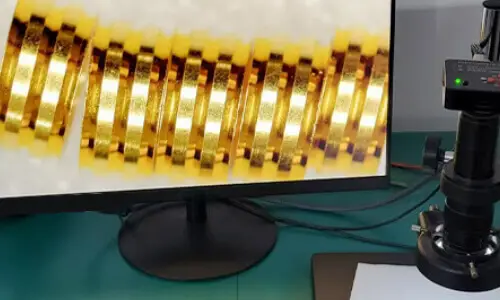
Electrical Slip Ring Internal Structure.
Ag–Cu–V alloy is a silver-based ternary alloy containing copper and vanadium. It exhibits excellent plastic workability, relatively high Vickers hardness and tensile strength, as well as low electrical resistivity, making it a suitable material for conductive slip rings. In this study, an internal defect detected in an Ag–Cu–V alloy conductive slip ring during ultrasonic inspection was investigated through chemical composition analysis, metallographic examination, scanning electron microscopy (SEM), and energy-dispersive spectroscopy (EDS). The formation mechanism of the defect was identified, and corresponding preventive measures were proposed.
Table of Contents
ToggleProcess-Related Issues
Conventional vacuum melting and casting processes involve relatively high melting temperatures and are prone to severe shrinkage during solidification. As a result, vanadium is difficult to incorporate uniformly into the Ag–Cu alloy matrix through direct casting. Furthermore, casting defects such as porosity and cracking, together with non-uniform dispersion of vanadium, are frequently encountered.
Internal defects in conductive slip rings, including cracks, pores, and inclusions, may lead to corona discharge or electromagnetic interference during service, adversely affecting current transmission and causing signal loss. With prolonged operation, near-surface defects may gradually emerge, resulting in poor contact between the brush wire and the slip-ring surface. In severe cases, electrical arcing and burn damage may occur. Therefore, ultrasonic inspection is essential before Ag–Cu–V alloy conductive slip rings are placed into service to ensure product reliability and quality.
Background of the Investigation
An internal defect was detected in an Ag–Cu–V alloy conductive slip ring during ultrasonic testing. To determine the origin of the defect and prevent recurrence, a series of examinations and analyses were carried out.
Experimental Examination and Analysis
Chemical Composition Analysis
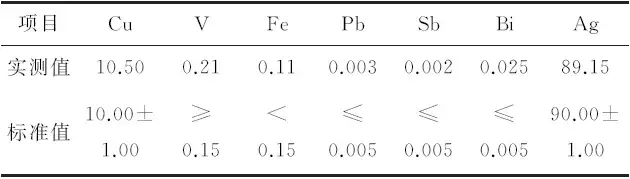
Chemical composition analysis was performed in accordance with the following standards:
- GB/T 15072.2–2008, Chemical Analysis Methods for Precious Metal Alloys—Determination of Silver in Silver Alloys by Sodium Chloride Potentiometric Titration;
- GB/T 15072.8–2008, Chemical Analysis Methods for Precious Metal Alloys—Determination of Copper in Gold, Palladium and Silver Alloys by Thiourea Separation and EDTA Back Titration;
- GB/T 15072.19–2008, Chemical Analysis Methods for Precious Metal Alloys—Determination of Vanadium and Magnesium in Silver Alloys by Inductively Coupled Plasma Atomic Emission Spectrometry;
- GJB 950A.1–2008, Methods for Trace Element Analysis of Precious Metals and Their Alloys—Part 1: ICP-AES Method.
The results showed that the contents of silver, copper, vanadium, and other impurity elements satisfied the compositional requirements specified in GJB 953A–2008, Specification for Precious Metal and Precious Metal Alloy Plates, Sheets, and Strips.
Ultrasonic Testing
Defect localization was conducted using a C-SCAN-ARS scanning inspection system in accordance with GB/T 2970–2016, Ultrasonic Testing Method for Thick Steel Plates.
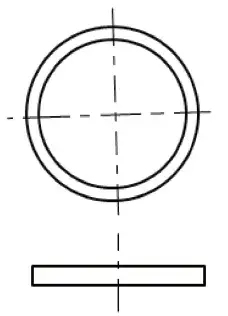
The Ag–Cu–V alloy slip ring had a thickness of 5 mm, an outer diameter of 125 mm, and an inner diameter of 120 mm.
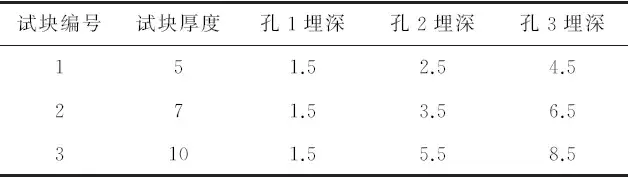
Conventional contact ultrasonic testing is unsuitable for thin plates with thicknesses of 5–10 mm because the inspection zone falls within the near-field region of the ultrasonic beam, making accurate defect characterization difficult. Since no dedicated national ultrasonic testing standard or reference block is available for plates thinner than 10 mm, a customized reference block with an acoustic path equivalent to that of the test specimen was designed according to standard reference-block design principles.
The defect echoes obtained from the specimen were compared with the flat-bottom-hole echoes of the reference block at corresponding depths. The reference block possessed the same surface condition and thickness as the tested specimen and was fabricated from the same material, with artificial defects being the only intentional discontinuities present.
Prior to ultrasonic inspection, the specimen surface was ground and polished. Immersion ultrasonic testing was then performed using a 10 MHz focused transducer.
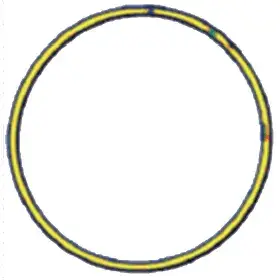
In the C-scan image, an inverted triangular feature located above the slip ring corresponded to the welded joint. Areas exhibiting bottom-wave attenuation were compared with the corresponding surface locations. When no surface damage was observed, the attenuation was attributed to internal defects. Combined analysis of the A-scan and C-scan results enabled further characterization of the discontinuity.
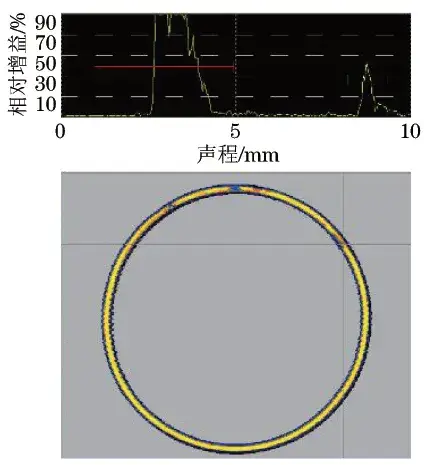
Significant attenuation of the back-wall echo was observed in the A-scan signal, confirming the presence of an internal defect and allowing its location to be determined.
Metallographic Examination
Metallographic examination was conducted using a Zeiss optical microscope. Sample preparation and analysis were carried out in accordance with GB/T 13298–2015, Method for Metallographic Examination of Metallic Microstructures.
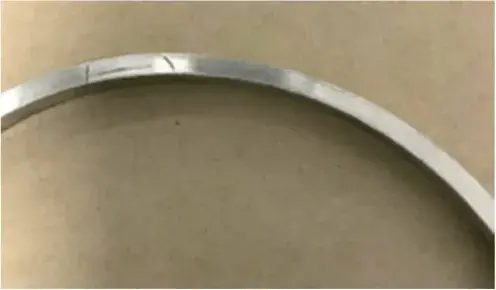
A specimen was sectioned from the defect region of the slip ring, mechanically polished, and examined under the microscope.
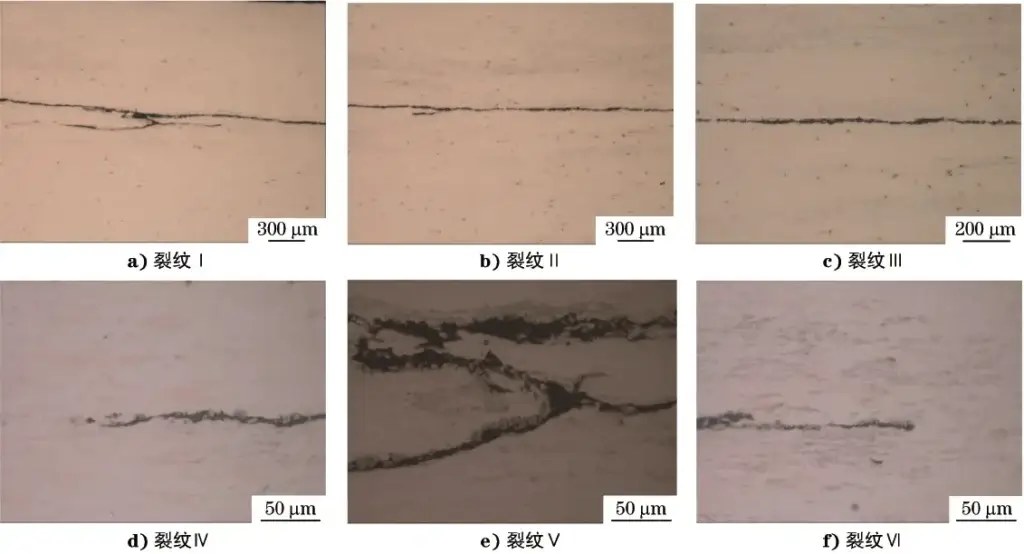
The crack propagation direction was found to be parallel to the ring surface. Distinct branching was observed within the crack, and the opposing crack faces could not be completely matched. In addition, relatively large particulate phases were distributed along both sides of the crack.
Scanning Electron Microscopy and EDS Analysis
The defect region was further examined using a Hitachi scanning electron microscope (SEM).
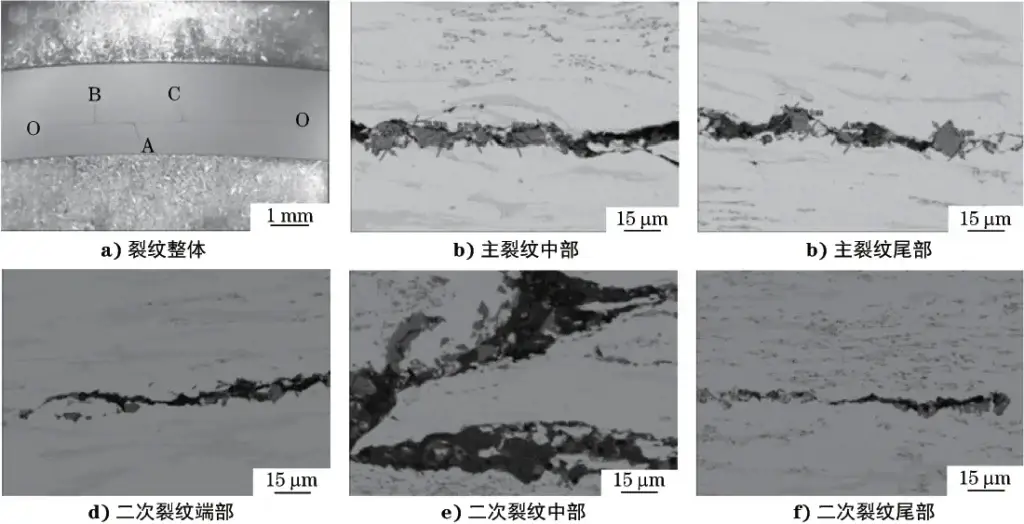
The crack appeared nearly linear and propagated longitudinally along the slip ring while exhibiting branching characteristics. Based on its morphology, the defect was identified as a linear crack. Following the T-shaped crack analysis method, the crack was divided into a primary crack (A), secondary cracks (B and C), and a crack origin (O).
The total crack length was approximately 100 mm. Black particulate phases with sizes ranging from 5 to 14 μm were observed on both sides of the crack.
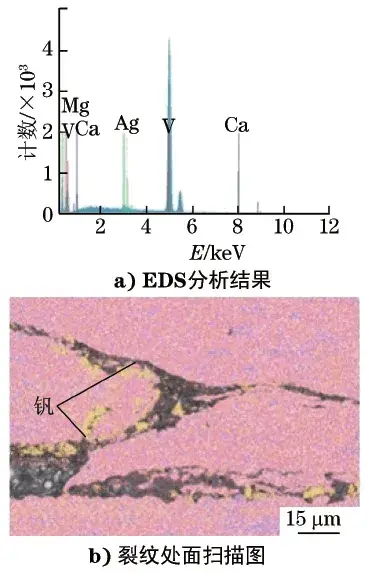
Energy-dispersive spectroscopy (EDS) analysis was performed on these particles. The results indicated that the particles consisted predominantly of vanadium. Moreover, vanadium segregation was clearly observed in the regions adjacent to the crack.
Discussion
The chemical composition of the Ag–Cu–V alloy conductive slip ring met the requirements specified in GJB 953A–2008.
The crack propagated parallel rather than perpendicular to the ring surface. Pronounced branching was observed, and the opposing crack faces could not be fully reassembled. The C-scan results showed that the crack was located far from the weld and outside the heat-affected zone, indicating that it originated in the base material rather than being associated with welding.
Large particulate phases were distributed along both sides of the crack. EDS analysis confirmed that these particles were vanadium-rich phases and that localized vanadium segregation existed in the crack vicinity.
Because the interfacial bonding strength between a second-phase particle and the matrix is relatively weak, stress concentration tends to occur at the particle–matrix interface when external loading is applied, particularly at sharp particle corners. These stress concentration sites reach the yield point earlier than the surrounding matrix, leading to localized plastic deformation. When the deformation exceeds the material’s allowable strain and the local stress surpasses its ultimate strength, microcracks are initiated.
The presence of coarse second-phase particles can significantly reduce the stress required for crack initiation. Once formed, cracks propagate progressively. Under uniformly distributed loading conditions, crack growth generally follows the path of least resistance, namely the weakest regions within the material. In the present case, crack propagation occurred preferentially along areas where the bonding between the vanadium-containing second phase and the Ag–Cu matrix was weak.
Conclusions and Recommendations
Ultrasonic inspection revealed that the internal defect in the Ag–Cu–V alloy conductive slip ring was a crack.
The crack originated from the weak and brittle interface between the vanadium-containing second phase and the Ag–Cu alloy matrix. Stress concentration at these interfaces resulted in the formation of microcracks, which subsequently propagated along regions of poor interfacial bonding and eventually developed into the observed internal defect.
To minimize the occurrence of such defects, the cooling rate during casting should be increased to promote a more uniform distribution of vanadium within the Ag–Cu matrix. Alternatively, powder metallurgy routes such as cold isostatic pressing (CIP), vacuum sintering, and extrusion may be adopted for the fabrication of Ag–Cu–V alloy conductive slip rings.
Here is a Further Slip Ring Engineering Guide for Engineers.
Source: Physical Testing and Chemical Analysis (Part A: Physical Testing), Vol. 56, No. 2, 2020
Author: Han Tianqi, Engineer
Beijing General Research Institute for Nonferrous Metals and Rare Earth Applications